
The 3-Asset Launch Stack: Product, Proof, and Pipeline for Solo Founders
Stop doing random launch things. Build one launch system with a product asset, proof asset, and email pipeline that turns attention into sales.

You open your inbox on a Tuesday night. One person asked a question on your landing page, two others clicked a link but didn't buy. You could panic, or you can run the 3-asset launch stack: product, proof, and pipeline. This system is built for solo founder launches, so you spend your time on the few things that actually move revenue.
With Zentoko's adaptive learning system, you can tighten the loop between what people ask, what you publish, and what your email pipeline sends, without turning your launch into a full-time job.
Here's the thesis: a solo founder doesn't win launches with volume. You win by shipping three specific assets that work together, then repeating the same pattern until the data looks boring.
The 3-asset launch stack in plain English
A 3-asset launch stack is a simple rule: every launch has three assets.
- Product asset: the page and offer people buy from.
- Proof asset: proof that answers the "why you, why now" question.
- Pipeline asset: the email sequence that moves clicks into buyers.
Build only one of these and you get exactly one of these outcomes: a landing page that pulls traffic but no sales, a social following that never converts, or a content pile with no path to purchase. The stack is how you stop guessing.
Think of it this way. Your product asset is the "yes" button. Your proof asset is the "I believe you" moment. Your pipeline is the "I need one more nudge" bridge.
A solo founder usually hits two hard constraints: you cannot create ten new things every week, and you cannot afford to wait months for "brand awareness." So you build the minimum launch system that can learn.
One useful mental model: your proof and product assets are what you publish once. Your pipeline is what you run repeatedly. You can reuse the same email sequence while you iterate on the offer.
This is also why proof-based marketing matters. People rarely buy because they saw your logo. They buy because your message matches their situation and you reduce risk with evidence, not vibes.
Research backs this up. Studies in marketing and behavioral economics consistently find that people rely on others' judgments under uncertainty, especially during first-time decisions. You don't need to become a scientist. You just need to make proof easy to find.
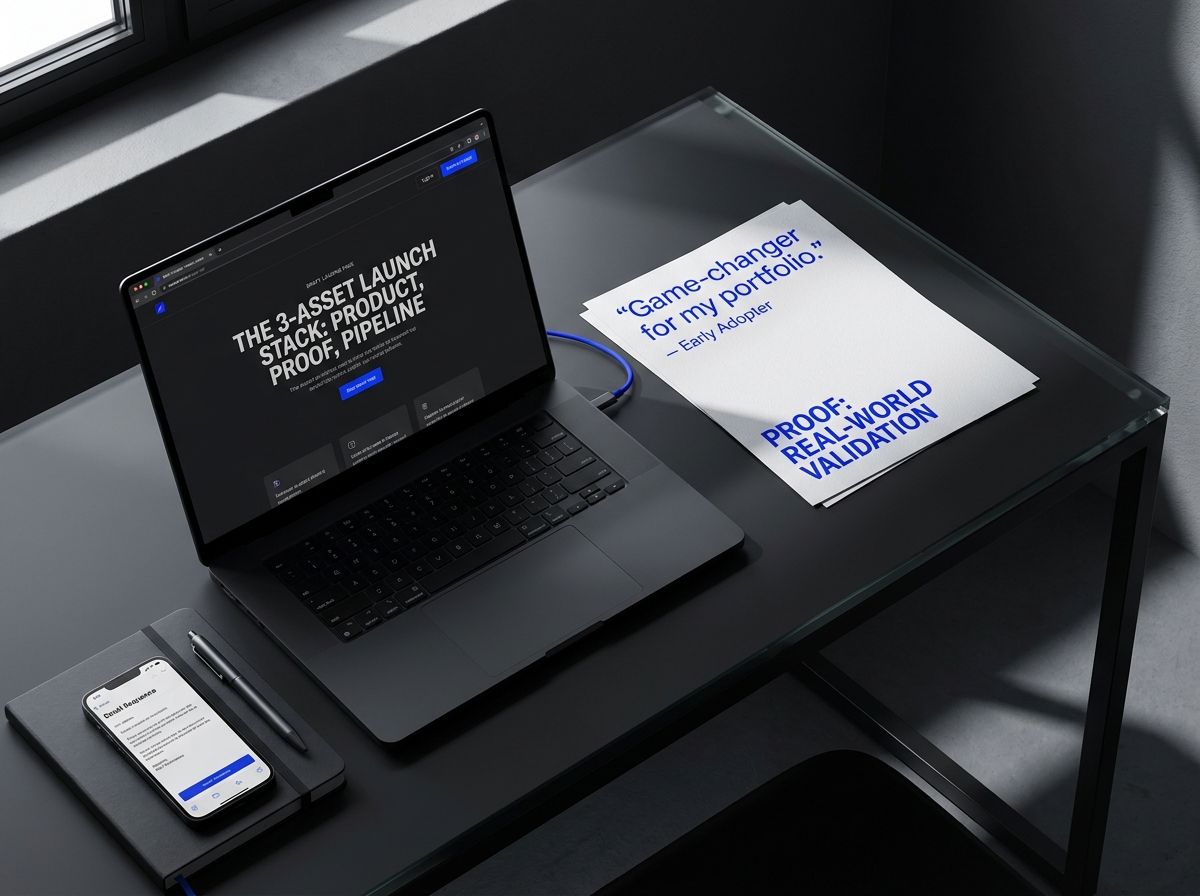
Asset 1: Product - build the offer people can say yes to
Your product asset is not "your product." It's the combination of offer, landing page, and purchase flow that makes buying feel straightforward.
If you're a solo founder, keep the product asset small enough that you can improve it fast. You are not building a museum. You are building a decision.
Start with three decisions: What exactly are you selling (one offer, one outcome)? Who is it for (one clear buyer type)? What is the next step (one action button)? Then write the page like you're talking to a specific person who's already leaning in.
Here's a scenario you can steal. In February, you launch a brand called "Kettle Notes," a newsletter for people who want to cook simple meals with what they already have. You have no following. You run the 3-asset stack anyway.
Your product asset includes:
- A single headline that names the outcome: "5-minute dinners from what you already have."
- A short promise section with a concrete mechanism: "Each issue has 3 recipes, one pantry swap list, and one 10-minute meal plan."
- Pricing that matches the buyer's risk tolerance: a low monthly rate with easy cancellation.
- A checkout that does not ask for a surprise account creation.
The landing page should answer five questions in under a minute: What is it? Who is it for? What do I get each week? Why is it different from the stuff I already tried? What happens after I buy?
If you can't answer those fast, you don't have an offer yet. You have a draft.
One more practical rule: align your page with your proof. If your proof asset says "people like you get results in 14 days," your product asset should not say "long-term transformation." Keep the story consistent.
Also, decide your "minimum viable purchase." You might sell a $19 starter, a $49 one-time kit, or a $99 cohort. The point is not the price. The point is getting enough early purchases to learn something real.
Asset 2: Proof - make belief cheap
Your proof asset is the fastest way to convert cautious clicks. It's also the easiest thing to overbuild.
So don't overbuild.
Proof-based marketing works because it reduces uncertainty. People want to know if your offer fits their situation and if others like them actually got value. Pick one proof lane and go deep: customer proof (testimonials, screenshots, case outcomes), expert proof (credentials, but only if they connect directly to the outcome), process proof (show your method, your steps, and what "good" looks like), or risk-reversal proof (guarantees, refunds, clear expectations).
A solo founder usually starts with process proof, because you don't have customers yet. That's fine. The stack is built to evolve.
Here's a scenario with a real moment. You're building a brand called "Sleep Map Studio," selling a guided bedtime routine for parents of kids who fight sleep. No testimonials on day one. But you do have a folder of notes from 20 parent conversations.
Your proof asset becomes:
- A "what we heard" section with 6 short quotes that mirror real pain points: "Bedtime used to be a negotiation," "We tried screens and it got worse," "We needed a plan for the 2am wake-up."
- A "here's the routine" section with a simple timeline: "Start wind-down at 7:10, dim lights at 7:25, last story at 7:40."
- A "why it works" explanation that does not sound like a textbook.
Then, when you get your first 10 buyers, you add one new proof element each week. No need to rewrite the whole page. Just update the proof block.
Conversion studies across e-commerce repeatedly show that testimonials and credibility cues improve trust and reduce decision friction. The mechanism is simple: when your buyer is uncertain, they look for signals that someone else already evaluated this and didn't get burned.
Your proof asset should be easy to scan. Keep it short and specific.
Use a formatting rule: one statement of outcome, one piece of evidence, one line connecting it to the buyer's situation.
Example:
Outcome: "Most parents see a calmer bedtime within 7-14 days."
Evidence: "One parent wrote, 'We stopped the 45-minute bedtime battles by day 10.'"
Connection: "That's usually when the routine stops feeling like a new rule and starts feeling predictable."
You are not trying to sound perfect. You are trying to sound believable.
Asset 3: Pipeline - turn attention into buyers on autopilot
Your email pipeline is the bridge between interest and purchase. It's also where your solo founder advantage shows up.
Most people treat email like a broadcast. You should treat it like a conversation that keeps going after someone shows intent.
A good email pipeline does three jobs: it answers objections before they become silent exits, it reminds people what they get and why it matters, and it creates a clean next step.
For a solo founder launch, you want a pipeline that is short, specific, and easy to update.
A practical starting sequence is 5 emails over 7 to 10 days:
- Email 1: welcome and promise. "Here's what you get and when."
- Email 2: story or problem. "Why this exists and what usually goes wrong."
- Email 3: proof. "What others are saying" or "what the process does."
- Email 4: objection-buster. "What if it doesn't work right away?"
- Email 5: offer close. "If you want it, here's the next step."
You can write all five with one source: your landing page.
If your landing page is strong, your emails get easier. You're not starting from zero. You're reusing the best lines, then adding the missing context.
Here's a scenario that plays out in real time. You launch a digital product called "Budget Bloom," a spreadsheet-based planner for people who want to stop overspending on subscriptions. On launch week, you run a small paid test or share content and get clicks. People land on your page, read, and leave.
Your pipeline triggers when they join your list or download a free sample. That matters because it gives you a reason to follow up.
Your pipeline emails can include:
- Email 1: "Here's the tool, here's how to use it in 10 minutes."
- Email 2: "The real reason subscription budgets fail."
- Email 3: "A screenshot of a planner before and after."
- Email 4: "How to make it work even if you feel behind."
- Email 5: "The offer ends Friday" or "Last chance for this price."
You don't need fancy automation. You need consistent follow-up.
And make your pipeline match your proof. If your proof is "parents see calmer bedtimes," your emails should talk about bedtime battles, not general wellness.
Now the part solo founders forget: your pipeline needs a feedback loop.
Track replies, clicks, and unsubscribes. Replies tell you what people are still unsure about. Unsubscribes tell you if your message feels off. Then update one thing each week: change a subject line, add one proof quote, or rewrite one objection section.
That's your brand launch system. Not a one-time event. A learning loop.
How to build the stack fast without burning out
You are a solo founder. You don't have time for a perfect plan.
So build the 3-asset launch stack in an order that reduces rework.
The order is simple: product asset first, proof asset second, pipeline asset third.
Why this order? Because your product asset tells you what to say. Your proof asset tells you what to show. Your pipeline tells you how to keep people moving.
But you still need a practical workflow.
Here's a week-by-week plan that fits in a normal life:
Day 1-2: Product draft
Write the landing page. Use one offer. Use one buyer type. Add a clear call to action.
Day 3-4: Proof sprint
Collect proof you already have: messages from DMs, notes from calls, screenshots of results from your own use, even "before/after" if you can explain it honestly. Then build one proof block on the page.
Day 5-6: Email pipeline draft
Write 5 emails using your page as the source.
Day 7: Launch a small test
Run a small push. You are not trying to go viral. You are trying to learn.
A key point: your first launch is not about perfection. It's about signal.
You want to answer these questions: Are people clicking the call to action? Are people buying? Are people asking the same questions repeatedly?
If clicks are happening but sales are not, your proof or offer clarity is off. If sales are happening but refunds are high, your expectations are misaligned.
Want a concrete example? Imagine you're launching "Trail Teas," a brand selling herbal tea blends for hikers. You publish a landing page with a strong description. You get clicks. Then zero purchases.
You look at your proof block and realize you only talk about ingredients. So you add a proof asset fast: one quote from a customer who used it on a weekend hike, one photo of the tea tin next to a trail map (process proof), and one "how it tastes" comparison you pulled from tasting notes.
Then you update pipeline email 3 to include that proof.
Within days, conversion improves. Because belief got cheaper.
With Zentoko's adaptive learning system, you can tighten this process by turning new questions into updated proof and email angles, instead of rewriting everything from scratch.
Common failure modes (and how to fix them)
Most solo founder launch problems are not "marketing problems." They are stack problems.
Here are the failure modes that show up again and again.
Failure 1: You build a product asset but skip proof
You write a landing page that sounds confident. No one believes it yet.
Fix: add one proof block within 48 hours. Even process proof counts. Show your method, your results, or your "what we heard" notes.
Failure 2: You build proof but the pipeline never follows up
You get comments and likes. Then people disappear.
Fix: connect proof to a pipeline. Your email sequence should reuse your proof lines and add the next step.
Failure 3: You launch with a pipeline but no clear offer
Your emails are good. The page is vague.
Fix: tighten the product asset. One outcome. One buyer type. One action.
Failure 4: You update everything at once
You change the landing page, rewrite emails, and swap the offer weekly.
Fix: change one variable per week. Keep the rest stable so you can tell what moved.
Failure 5: You chase too many audiences
You write for "everyone." Then you wonder why no one buys.
Fix: pick one buyer type for this launch. You can expand later.
If you want a simple diagnostic, use these questions: When a stranger lands on your page, do they know what to do in 30 seconds? If not, your product asset is unclear. When a buyer reads your proof, do they feel like you understand their situation? If not, your proof asset is generic. When someone clicks but does not buy, do they get a helpful follow-up within 24 hours? If not, your pipeline is missing.
That's the stack. It's not magic. It's just structure.
A real solo founder launch pattern you can repeat
Here's a repeatable pattern you can run for any niche brand.
Step 1: Choose one offer you can deliver this month
Not "eventually." This month.
Step 2: Write your product page before you write content
Content can wait. Your product page is the anchor.
Step 3: Create one proof asset from real notes
Use what you already have. If you have zero customer proof, use process proof and "what people told me" proof.
Step 4: Build a 5-email pipeline that follows the same story
Email 1 repeats the promise. Email 2 explains the problem. Email 3 adds proof. Email 4 handles the main objection. Email 5 closes.
Step 5: Run a small traffic test and watch behavior
Track clicks to checkout, not just page views.
Step 6: Improve one thing per week
Add proof. Tighten the headline. Update one email.
Now let's make it concrete.
You're in Lisbon for the weekend. You sit in a cafe with your laptop after a long walk and draft your launch page for "Lisbon Loop," a micro brand selling walking routes for people who want a calmer pace. No big audience, no problem.
You write the product asset as if the buyer is already planning a trip.
Then you add proof: a short list of "what people said after using the route" from beta testers, a screenshot of a completed map with markers, and one risk reversal: "Refund if you do not find at least one route you can finish in under 90 minutes."
Then you build the email pipeline:
- Email 1: "Pick your pace and choose a route."
- Email 2: "Why most travel content overwhelms you."
- Email 3: "What beta testers liked most."
- Email 4: "What if it rains?"
- Email 5: "Get the bundle before Sunday."
You run the test for a week and get your first sales. Then you add one more proof line based on replies. That's the stack doing its job. Product gives you a place to buy. Proof gives people a reason to trust. Pipeline gives them a reason to come back.
FAQ
What is the 3 asset launch stack?
The 3 asset launch stack is a simple launch system with three parts: a product asset (your offer and landing page), a proof asset (evidence that reduces uncertainty), and an email pipeline (messages that move clicks into purchases). Together, they turn attention into revenue without requiring a big audience.
How do I do solo founder launch when I have no audience?
You still build the stack. Create a clear product asset with one buyer type and one outcome. Use proof you can generate fast, like process proof and "what people told me" notes. Then run a short email pipeline so interested visitors get follow-up within 24 hours.
What should my proof be if I have no customers yet?
Use process proof and situation proof. Show your method, your steps, and your "what we heard" from DMs, calls, or beta users. If you used the product yourself, include honest before/after notes. The goal is not perfect testimonials. The goal is believable evidence.
How long should my email pipeline be for a launch?
For a solo founder launch, start with 5 emails over 7 to 10 days. Keep them focused on the same story as your landing page. Update proof and objections based on replies and clicks rather than rewriting everything.
What metrics should I watch during the launch?
Watch checkout clicks, purchases, and reply volume. If you get clicks but no sales, your proof or offer clarity is off. If you get sales but many refunds or complaints, your expectations and onboarding may be mismatched.
Next step: build your stack in one evening
Open your notes app and write three headings: Product, Proof, Pipeline.
Then do this in order:
- Write your landing page promise and call to action.
- Add one proof block using whatever evidence you already have.
- Draft your 5-email pipeline using your page as the source.
Do that tonight, and you'll have a real brand launch system by tomorrow. Then you can test, learn, and improve without burning weeks on random content.
Join the conversation
Subscribe to comment
Join the Ziggyloo family newsletter to leave a comment — and get gentle learning tips and community stories in your inbox. No spam, unsubscribe anytime.