
The minimum viable brand: what to create before you start selling
You do not need a full brand system to make your first sale. Here is what to create, what to skip, and how to launch with less risk.
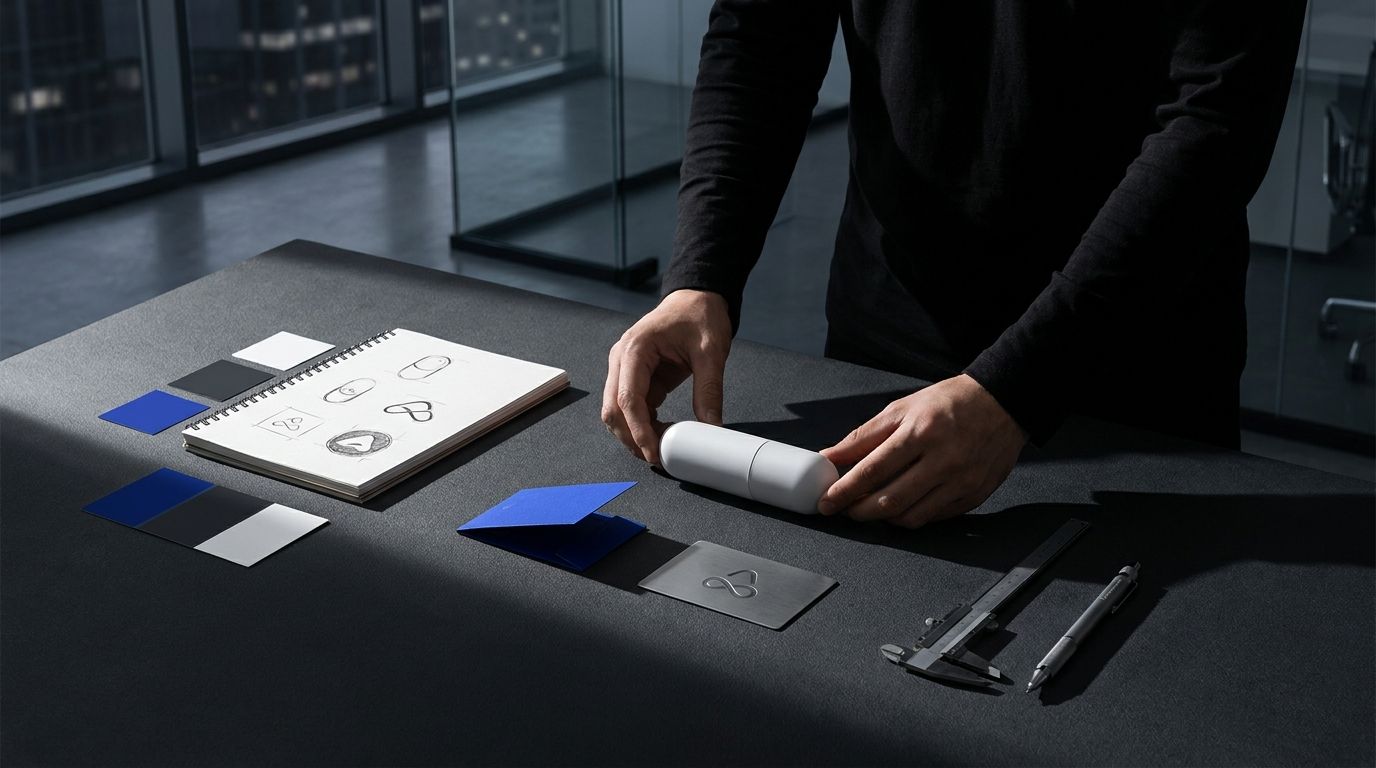
Elena had three tabs open, a logo draft she hated, and a half-finished product sitting next to her coffee. She'd spent four evenings choosing between two shades of green. Neither shade made a single person buy.
A minimum viable brand is the smallest set of brand assets that helps the right customer understand, trust, and buy your offer. Before you start selling, create a clear promise, a focused offer, a simple visual system, and one place where people can take action. Skip the polished extras until real customers give you evidence.

That can feel genuinely uncomfortable. You may have spent weeks on names, colors, taglines, and imaginary future products. The work feels productive because it's easier than asking someone to pay. (I have personally rebuilt a landing page just to avoid sending one awkward sales message, so there's no judgment here.)
What a minimum viable brand actually needs
A minimum viable brand is not a sloppy brand. It's a brand with a narrow job: make your offer easy to recognize and easy to consider.
You are not building the final version. You are building enough structure to run a fair test. That distinction matters when you're a solo founder or managing several niche brands at once.
Your first version needs four working parts:
- A specific customer: describe the person, situation, or job your offer is for.
- A clear promise: explain what changes after someone buys.
- A credible offer: state what they receive, how it works, and what it costs.
- A simple action path: give them one obvious way to buy, join, book, or ask a question.
If any of these parts is missing, the logo cannot rescue the launch. A beautiful identity wrapped around a vague offer is still vague. It just looks more expensive.
Your brand promise should answer a question customers already carry around. It might be, "I need five weekday dinners without planning every Sunday," or, "I need product descriptions for my small shop without hiring an agency." The wording does not need to sound clever. It needs to sound familiar to the person who has the problem.
Write the promise in one sentence using this shape:
- For [specific customer]
- Who needs [specific result]
- This is [offer]
- That helps them [practical outcome]
You do not have to publish that exact template. Use it to remove fog. If you cannot finish the sentence without piling in several audiences or outcomes, narrow the idea before you spend more money.
What should your first customer understand?
Your first customer should understand who the offer is for, what it does, why it may work, and what to do next. They do not need your complete founder story, five years of vision, or a manifesto about disrupting an industry.
Ask someone outside your project to read your offer for ten seconds. Then ask:
- Who is this for?
- What do you think it helps with?
- What would you expect to pay?
- What would stop you from trying it?
Their answers are not a verdict on your talent. They're a reading of the message. If they miss the offer, the message needs work before the brand needs more decoration.
The brand launch essentials to create before selling
The phrase brand launch essentials can sound like a shopping list: a complete design kit, a photo shoot, printed packaging, custom illustrations, a content library. For a lean launch, it means something smaller and more useful.
Create these assets before you sell:
A one-page brand brief
Keep this in a document you can change quickly. Include:
- The customer and the moment that sends them looking for help
- The problem in the customer's own words
- Your offer and its plain-language result
- Three beliefs that guide your decisions
- The tone you want in emails, pages, and posts
- The claims you can support
- The one action you want people to take
The tone section should be practical. "Warm but not sugary" tells you more than "modern and inspiring." "Direct, calm, and useful" is something you can actually apply while writing a sales page at 10:47 p.m.
Your beliefs do not need to be grand. A small meal-planning brand might believe that dinner should reduce household friction, not create another performance test. A niche bookkeeping service might believe that business owners deserve numbers they can read without a finance degree.
These beliefs help you make decisions when the brand grows. They also give your content a point of view, which is more useful than a string of disconnected tips.
A simple visual system
You need a wordmark or plain text treatment, one primary color, one supporting color, one typeface, and a repeatable image style. That is enough for a landing page, an email, and a social post.
Choose assets you can use without a designer. Test the system in these places:
- A mobile landing page
- A square social graphic
- An email header
- A product thumbnail
- A plain text sales message
If the design falls apart outside a polished mockup, it is not ready. Your brand will spend most of its early life in ordinary places: a phone screen, a checkout page, a community post, or a shared link.
Do not spend your early budget on every possible format. You can add packaging, motion graphics, photography, and custom illustrations after you see what customers actually respond to. Lean branding is not about caring less. It's about giving your care a better order.
A focused offer page
Your offer page needs to carry the sales conversation when you are not there to explain things. Keep it short enough to read and specific enough to trust.
Include:
- The problem your customer is trying to solve
- The result they can reasonably expect
- What is included
- How the process works
- Who it is not for
- The price and purchase terms
- A clear button or reply option
- Answers to the objections you hear most often
The "who it is not for" section earns its place. It stops poor-fit sales and helps the right customer feel recognized. You are allowed to say that a package is for new shop owners, not established retailers with an internal marketing team.
A page does not need to prove you can solve every adjacent problem. It needs to help one person decide about one offer.
A basic proof system
You can sell before you have testimonials. You cannot sell responsibly if you make claims you cannot support.
Use early proof in forms that match your stage:
- A sample or walkthrough of the product
- A founder explanation of why you built it
- A small result from a test user
- A clear refund or revision policy
- A description of your method
Label examples honestly. "Sample plan" is better than making a sample look like a customer result. People can handle a new brand, they are less patient with a brand that pretends to be older than it is.
With Zentoko's lean brand launch system, you can keep the brief, offer copy, channel assets, and launch notes in one working place while the brand is still changing. The point is not to make the process feel grand. It's to reduce the number of loose documents you forget to update.
What to leave out for now
The fastest way to build a minimum viable brand is to stop adding things that do not help a customer make a decision.
Leave these out until the offer has some evidence behind it:
- A long brand story that does not explain the offer
- A full visual identity with many logo variations
- A large content library for channels you have not tested
- Paid packaging with no clear reason to choose it
- Several products aimed at different customer groups
- A complicated loyalty or referral program
- A brand voice guide longer than the offer page
This is not permission to be careless. It's permission to delay work whose value depends on information you do not have yet.
You may not know which customer phrase will become part of your public language. You may not know whether buyers care more about speed, price, convenience, status, or relief. You learn those things by putting a clear offer in front of real people.
Some decisions should stay temporary. Use a working color. Use a simple domain if the perfect one is taken. Use a text logo while you test demand. The early version is allowed to have tape on it. Most useful things do, at some point.
When is a brand asset worth creating?
Create an asset when it helps a customer understand the offer, trust a claim, remember the brand, or take the next step. Delay it when it mainly helps you feel finished.
That test can feel a little blunt. It is also effective. Ask what job the asset does and how you will know whether it did that job.
A second sales page may help if people ask the same question repeatedly. A branded notebook probably does not help yet. A short comparison chart may reduce buying hesitation. A second logo lockup probably will not.
You are not banning polish forever. You are putting polish after learning.
How to launch a brand quickly without looking rushed
If you are wondering how to launch a brand quickly, set a small launch boundary. Pick one audience, one offer, one main sales page, and one place to find potential customers.
A useful seven-day build might look like this:
- Day one: write the customer problem, promise, offer, and price.
- Day two: interview three people who fit the audience.
- Day three: revise the promise and write the offer page.
- Day four: choose the visual basics and create reusable templates.
- Day five: prepare one useful piece of content and one direct sales message.
- Day six: check the buying process on your phone and fix unclear steps.
- Day seven: invite people to buy, book, join, or reply.
The schedule is not magic. It is a limit. Without a limit, branding work expands until the launch becomes a vague future event.
Before you publish, run a practical check:
- Can a stranger explain the offer after a quick read?
- Can the customer see the price without asking you privately?
- Does the purchase or booking path work on mobile?
- Are your claims supported by a sample, method, or early result?
- Do your posts lead to the same offer instead of five directions?
- Can you deliver what you are promising this week?
That last question deserves more attention. A brand launch is not successful because the page went live. It is successful when you can keep the promise after somebody says yes.
If your product is not ready for a full sale, use a paid pilot, a limited founding offer, or a deposit-based pre-order. Be clear about timing and what the buyer receives. A small paid test gives you better information than a large audience politely saying the idea looks nice.
How do you know the brand is ready to sell?
Your brand is ready to sell when a specific customer can understand the offer, see a credible reason to try it, and complete the next step without a private explanation from you.
You do not need universal approval. You need enough clarity for a small group of suitable people to make an informed decision. Some will say no. That is part of the test, not proof that you should rebuild everything.
Track the questions people ask. Repeated questions usually point to missing copy, not a broken business. If people ask whether the offer is for them, clarify the audience. If they ask what happens after payment, clarify the process. If they ask why it costs what it costs, explain the work and result more plainly.
Do not turn every comment into a new feature. Look for patterns across several conversations. One person's preference can be noise. A repeated hesitation is a message problem worth investigating.
Your next step is smaller than you think
Open a blank document and write five lines:
- This brand is for...
- They are trying to...
- I help by...
- They receive...
- The next step is...
Then send those lines to one person who resembles your customer. Not your most supportive friend. Someone who might actually need the offer.
Ask them what they think you sell and what feels unclear. Let the silence sit after you ask. It will feel longer than it is, and you may want to fill it with backstory, but the confusion is useful data.
Use what you learn to tighten the page. Then invite a small number of people to buy. You can improve the colors later. You can rewrite the about page later. You can even change the name later if the offer earns that decision.
The minimum viable brand is not a consolation prize for founders without enough time or money. It is a sensible starting point for anyone who wants evidence before expansion. Your unfinished brand can still be honest, useful, and worth paying for.
You are not behind because the work is not polished. You are at the part where the market gets a chance to answer back. Make the promise clear, make the next step easy, and let real customers help you decide what deserves to exist next.
FAQ
What is a minimum viable brand?
A minimum viable brand is the smallest set of brand elements needed to explain an offer, build basic trust, and support a sale. It usually includes a clear audience, promise, offer page, simple visual system, and direct action path.
What are the brand launch essentials for a new business?
The brand launch essentials are a focused customer and problem, a clear promise, a credible offer, basic visual consistency, proof or transparent reasoning, and a working way to buy. You do not need a full identity system or a large content library before your first test.
How can I launch a brand quickly without making it look cheap?
Keep the scope narrow and make the basics consistent. Use one clear offer, one simple visual system, one sales page, and one channel while you test demand. Clear copy and reliable delivery make a new brand feel more trustworthy than expensive decoration.
Should I create a logo before I start selling?
Create a simple wordmark or text treatment if it helps people recognize your materials. Do not delay selling for a custom logo, multiple logo versions, or a complete identity system. The offer and customer promise carry more weight at the start.
Join the conversation
Subscribe to comment
Join the Ziggyloo family newsletter to leave a comment — and get gentle learning tips and community stories in your inbox. No spam, unsubscribe anytime.