
The Solo Founder’s 14-Day Launch Sprint: From Idea to First Sales
You can go from an idea to first sales in two weeks by shipping a minimum viable launch and running a daily brand launch plan that doesn’t stall.

You have a laptop open on the kitchen table. The sink is running in the next room. You need first sales, not a perfect brand.
A 14-day launch sprint is the simplest way to get there: pick one offer, build the minimum viable launch assets, publish on a tight schedule, and run daily tests until someone buys. This plan is built for solo founder reality: limited time, limited patience, and zero tolerance for "we'll do it next month."
If you follow this, you will not just "prepare." You will ship.
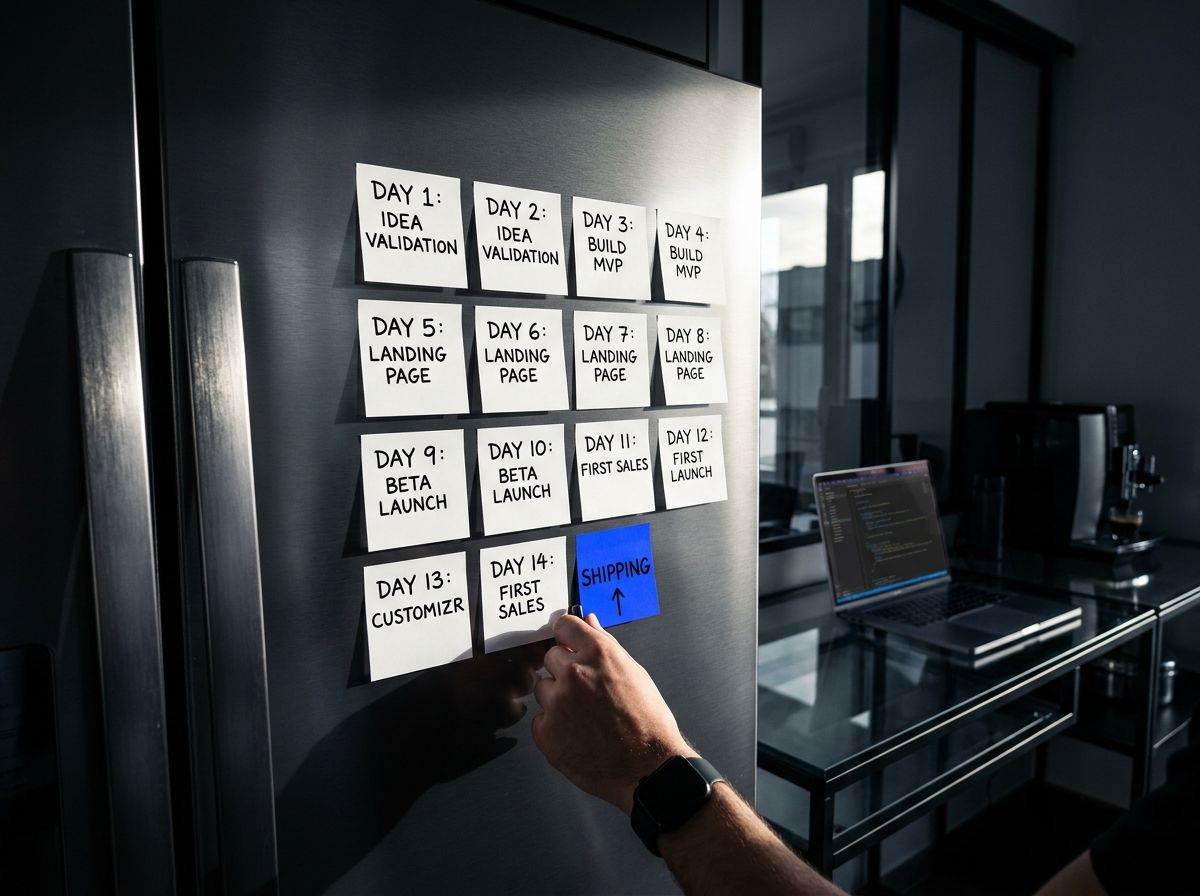
What a 14 day launch sprint is (and what it is not)
A 14-day launch sprint is a time-boxed brand launch plan where every single day produces something you can ship or sell. You are not researching forever. You are not building a five-page site with a brand book attached. You are building the smallest version of your launch that can actually convert.
Here is the thesis in plain terms: you trade "more polish" for "more attempts." In launch terms, attempts are actions that create chances to buy: publishing an offer, sending an email, running a short ad test, posting a demo, replying to leads, making it easy to say yes.
What it is not:
- It is not a 14-day "marketing sprint" where nothing changes in the offer.
- It is not a slow website build disguised as strategy.
- It is not a launch where you wait for perfect social proof.
What it is:
- A minimum viable launch that is good enough to sell.
- A schedule that forces progress.
- A loop: publish, measure, adjust, repeat.
A useful reality check: buyers often need multiple touches before they commit. Repeated exposure increases recall and purchase intent, and email and retargeting work partly because they manufacture those repeated touches. You do not need a huge audience. You need enough consistent signals that the right people notice.
So your sprint is designed to create those signals fast.
The sprint outputs you should aim for
By the end of day 14, you should have:
- One clear offer with a price and a promise
- A landing page or sales page (even a bare-bones one)
- A single checkout path
- 5 to 10 pieces of launch content
- One email sequence that drives people to buy
- A daily habit of outreach or replies
If you cannot name these outputs, you are not running a sprint. You are running a hope.
Days 1-3: Lock the offer and define your minimum viable launch
Day 1 is where launches go to die, because founders start "thinking" instead of deciding. Your job is to pick one offer and make it sellable without drama.
Start with this question: what are you selling in plain language? Not in your head. In one sentence. Example: "I help busy parents cut screen time without nightly fights using a 14-day routine and weekly coaching." That is an offer.
Then answer three more questions. Write them down. No brainstorming circles.
1) Who is it for? Be narrow enough that you can find them.
2) What problem does it solve in the first week?
3) What is the simplest proof you can show right now?
Proof does not always mean "I have 2,000 customers." Proof can be:
- Your experience (what you did, what you learned)
- A demo (show the result, show the workflow)
- A pilot (a small group you help for cheap or free)
A minimum viable launch is not "cheap." It is "small and complete." For a solo founder launch, that usually means:
- One product or one package
- One landing page
- One checkout
- One primary call to action
Concrete scenario: "Mara and the newsletter course"
Mara runs a small newsletter about meal planning in Austin. She wants to launch a course. On day 1, she tries to build a full course site and a brand identity, then stops. On day 2, she decides on a single offer: "Meal Plan in 30 Minutes a Week" with a 5-module workbook and 3 live Q&A sessions. She creates one page with a short video, a sample workbook page, and a checkout link. By day 3, she has the offer locked.
She did not "finish branding." She finished selling.
Concrete scenario: "Devon and the template pack"
Devon builds Notion templates for real estate agents. He wants to launch a pack. On day 1, he keeps rewriting the description. On day 2, he picks a single persona: "agents who manage 200+ leads and need follow-up automation." On day 3, he ships a landing page with screenshots and a free mini template, using the mini template as the demo and the pack as the paid offer.
The minimum viable launch is not about perfection. It is about reducing confusion.
Your brand launch plan should include the offer promise
Your offer promise needs a time frame. Not "improve productivity." Say "cut your weekly planning time from 2 hours to 30 minutes." If you do not have that exact number, use a conservative promise you can actually back up.
A good promise helps your content do its job.
Days 4-7: Build the assets that sell (without building a brand museum)
Now you build. But you build only what the sprint needs.
Most solo founders overbuild assets because hiding behind "production" feels safer than shipping. Production is not the goal. Conversion is.
You need a small set of assets that work together.
The minimum asset stack for first sales
Use this as your brand launch plan skeleton.
- Landing page: headline, who it is for, what they get, price, FAQs, and a clear call to action
- One short video or demo: 60 to 120 seconds is enough
- 5 to 10 launch posts: each one should point to the offer
- Email sequence: 3 emails minimum
- A simple follow-up method: reply to comments, DM leads, or track link clicks
A quick note on landing pages
If you are tempted to build a fancy site, resist. A landing page that loads fast and answers questions wins. You can use a plain template and still look credible.
And your landing page should sound like you. Not like a marketing blog.
Concrete scenario: "Kira in Chicago and the coaching offer"
Kira lives in Chicago and coaches new dog owners. She has testimonials from past clients but no formal case studies. On day 4, she writes her landing page with a simple structure:
- Headline: "New dog owners: stop guessing and start training with a 7-day plan"
- What they get: videos, checklists, and weekly feedback
- Proof: 3 short quotes from real clients and a paragraph about her training approach
- FAQs: "Do I need experience?" "What if my dog is anxious?"
On day 6, she records a video walking through the plan. On day 7, she publishes and turns on checkout.
She did not wait for "better testimonials." She shipped.
Your email sequence should be short and direct
A 3-email sequence that works for most minimum viable launches:
- Email 1 (launch day or day before): announce the offer and who it is for
- Email 2 (24 hours later): address objections and show what they get
- Email 3 (final push): include urgency and a clear last call
Urgency is not hype. It is a real constraint. "Cohort starts Monday" or "I can only take 20 clients this sprint" are both legitimate reasons to act now.
If you do not have a cohort, use a constraint like "I will pause enrollment after 48 hours to keep onboarding manageable."
Create launch content that matches the buyer's questions
Your launch posts should answer questions your buyer already has. For example:
- "Is this for people like me?"
- "What do I actually get?"
- "Will this work if I am busy?"
- "What happens after I buy?"
Do not post generic motivation. Post answers.
If you can write 10 posts in one sitting, do it. Use that time.
Days 8-10: Run the launch window and drive first sales
Days 8 to 10 are your "publish and sell" stretch. This is where you stop preparing and start doing.
Your goal is not to "go viral." Your goal is to generate enough buyer intent that someone pulls the trigger.
Run the launch window like a machine:
- Post your core offer message every day
- Send your email(s) at set times
- Reply to every comment and DM
- Track clicks and conversions
A simple schedule that works for solo founders
Pick one time block and repeat it. Every day.
A daily cadence you can run:
- Morning: post or email, then reply for 20 minutes
- Midday: one value post plus a link back to the offer
- Evening: one proof post or demo clip plus final replies
You are not trying to be everywhere. You are trying to be consistent.
What to say when someone is interested
You will get "Is this for me?" messages. Have answers ready.
Use a short reply template:
- Confirm their situation
- Explain who the offer is for
- Point to the landing page section that answers their question
- Ask one question that helps you qualify
This is how you turn attention into first sales.
Concrete scenario: "Luis and the weekend sprint"
Luis sells a weekend workshop for small business owners in Phoenix. He runs his launch window Friday through Sunday. On day 8, he posts a short story about the workshop outcome and links to his landing page. On day 9, he emails a "what you'll do in 2 hours" breakdown with screenshots included. On day 10, he posts a demo clip and answers every comment within 30 minutes.
He gets his first sale Sunday night after a DM reply that clarifies the time commitment.
That is the pattern. The sale happens after the confusion gets removed.
Track the right signals
You want three signals, not 30 dashboards:
- Clicks: are people interested?
- Conversions: are people willing to buy?
- Replies: are people confused?
If clicks are high but conversions are low, your landing page promise or pricing is probably the problem. If clicks are low, your content is not reaching the right people, or your message is unclear.
Days 11-14: Improve fast and extend the reach without starting over
Most founders treat the final days as "hope." Treat them as iteration instead.
By day 11, you should know what is working. Not perfectly. But enough.
Run a mini post-mortem every day
Spend 20 minutes on day 11 and repeat it each morning after.
Answer these:
- Which post drove the most clicks?
- Which email had the most replies or sales?
- What questions did people ask repeatedly?
- What part of the landing page did they hesitate on?
Then make one change per day. Not ten.
Examples of one-change improvements:
- Rewrite the headline to match the buyer's exact words
- Add one FAQ question that keeps showing up in DMs
- Replace a generic benefit with a concrete example
- Shorten the page and move the price higher
- Add a short proof section: "who it is for" and "who it is not for"
Extend the launch without relaunching
You do not need a brand new launch. You need a continuation.
You can extend by:
- Posting the same offer again with a different angle (time, outcome, story)
- Running a small "last chance" push
- Offering a bonus to early buyers if you can actually deliver it
Bonuses work when they are tied to delivery capacity. If you cannot deliver it, do not promise it.
Minimum viable launch does not mean minimum viable follow-through
If someone buys, your job is to deliver onboarding fast. That is how you earn the proof you will need for the next sprint.
Ask for feedback in week one. Keep it simple:
- What was hard before?
- What changed after?
- What would make this even easier?
Those answers become your next landing page copy. (Seriously, buyers will hand you the exact language if you ask.)
Concrete scenario: "Sana and the objection rewrite"
Sana launches a budgeting template for freelancers. She gets clicks but few sales. On day 11, she reads the DMs. People keep asking, "Is this for people who use spreadsheets?" Her landing page says "works with spreadsheets" but does not explain enough.
On day 12, she updates the page with a screenshot and a short paragraph: "If you use Google Sheets, you can copy this template in 60 seconds." On day 13, she posts a quick tutorial clip. On day 14, she adds an FAQ: "Do I need accounting knowledge?"
Sales follow after the objection gets answered in the exact place the buyer is stuck.
Adaptive learning systems keep your content and onboarding aligned
With an adaptive learning system, you can turn the questions you see during the sprint into clearer next steps, so your offer and your follow-up stay connected. That matters because first sales depend on reducing confusion at the moment someone is ready to act.
If you are running multiple niche brands, this kind of tight feedback loop is how you avoid repeating the same launch mistakes across your portfolio.
How to run the sprint as a solo founder (daily checklist)
Here is the part you actually need: a daily checklist you can run without overthinking it.
Your sprint is 14 days. Your job is to keep the machine moving.
Daily checklist during the 14 day launch sprint
Use this every day, especially days 4-14.
- Publish: 1 post or 1 email (or both if you can)
- Sell: link to the offer once per day
- Reply: respond to every comment and DM within 30 to 60 minutes during your work block
- Measure: check clicks and conversions
- Improve: pick one change for the next day
That is it.
How to avoid the solo founder trap
The solo founder trap is "I do everything, so I must do it perfectly." You do not. You do the smallest version of each task well enough to ship.
If you need a rule, use this one: if it does not affect the buyer's decision, it is optional.
Examples:
- Optional: redesigning your logo during the launch window
- Optional: writing a long brand manifesto
- Optional: adding a second checkout option
- Not optional: clarity on what they get, how long it takes, and what it costs
What to do if you have zero audience
If you have no audience, your sprint still works. You just need to add outreach.
Outreach is not spam. It is targeted conversation.
A practical outreach method:
- Identify 25 people who match your buyer
- Comment on 10 posts with a real, specific point
- Send 5 to 10 DMs that reference their situation and ask one question
Then point them to your landing page only if they ask.
In early launches, the fastest path to first sales is direct conversation, not content alone.
What to do if you made sales but they were slow
Slow sales usually mean one of three things:
- Your offer promise is too vague
- Your landing page is missing an objection answer
- Your content reaches the wrong people
Fix one thing per day. Track clicks after the change.
You will see a shift if you are fixing the right bottleneck.
FAQ
How do I pick the right offer for a solo founder launch in 14 days?
Pick an offer you can explain in one sentence and deliver immediately. If you cannot deliver it within a week of purchase, simplify it. Your goal is minimum viable launch, not a future product.
What counts as minimum viable launch assets?
A sales page with clear pricing and what they get, a single checkout path, and enough content to answer buyer questions. You also need at least a short email sequence to drive first sales.
How many posts and emails should I publish in a 14 day launch sprint?
Aim for 5 to 10 posts and 3 emails minimum. During the launch window, publish daily and link back to the offer, then adjust based on clicks and replies.
What if I get clicks but no first sales?
Assume the landing page is missing a decision detail. Check your headline, your promise time frame, and your FAQs. Then add one objection answer that you keep seeing in DMs.
How do I handle follow-up after someone buys during the sprint?
Send onboarding fast and ask for feedback in week one. That feedback becomes your next sprint's proof, which makes future first sales easier.
Your next step
Pick your offer today and write the one-sentence promise. Then block calendar time for day 1 to day 3 tasks: define the buyer, lock the minimum viable launch, and publish a simple sales page with checkout.
Tomorrow, start shipping content that answers the buyer's questions. You are not waiting for readiness. You are building momentum toward first sales.
Join the conversation
Subscribe to comment
Join the Ziggyloo family newsletter to leave a comment — and get gentle learning tips and community stories in your inbox. No spam, unsubscribe anytime.