
The multi-brand production loop: repurpose once, publish everywhere, still feel original
You can ship multiple brands without sounding like a copy machine. Build one production loop that repurposes fast and still keeps each brand feeling like it belongs.

Elena was hunched over her laptop at the kitchen table, the kettle screaming like it had a personal grudge. Her notes app had three tabs open: one for her skincare micro-brand, one for her meal-prep brand, and one titled "why am I doing this again." She'd written a solid post for Monday, then spent an hour rewriting it for Tuesday. Again.
She paused, not because she got smarter, but because she realized her workflow was demanding she create from scratch every single time. That's not a creative problem. It's a production loop problem.
If you run a multi-brand workflow, the fix is simple to say and genuinely annoying to implement: repurpose once, publish everywhere, and use structure so each brand still feels original. With Zentoko's adaptive learning system, you can turn one strong production into multiple on-brand outputs without losing your voice.
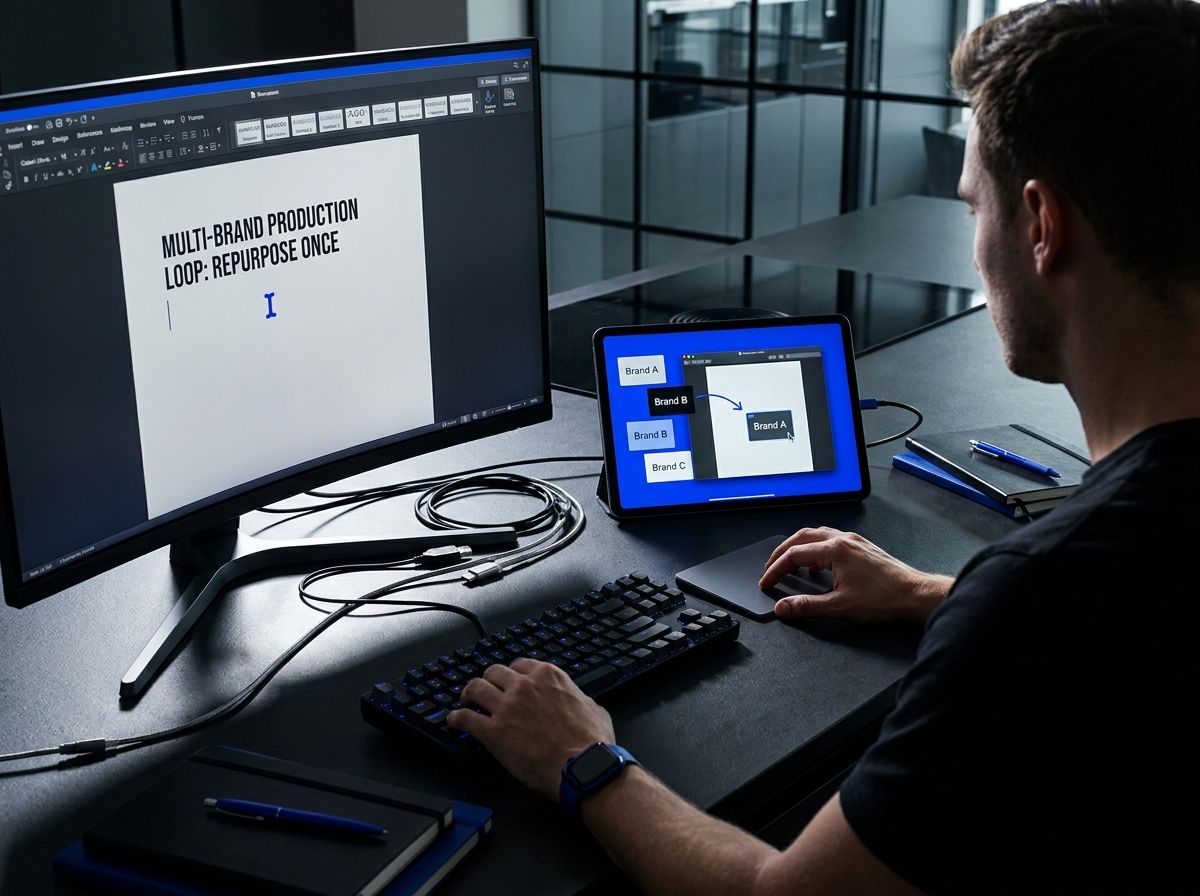
The loop you actually need: one build, many publishes
Most multi-brand workflows collapse for the same reason. You write one thing, then you "adapt" it for the next channel or brand. Adaptation sounds harmless. It's also where hours go to die.
What you actually want is a loop that separates creation from variation.
Creation is where you earn the idea. Variation is where you package it for each brand and each channel.
Here is what that looks like in practice. Think in layers:
- Layer 1: The core asset (one concept with proof and a clear next step)
- Layer 2: The message variants (different angles, hooks, and CTAs)
- Layer 3: The channel formats (post, email, short video script, carousel text)
- Layer 4: The brand overlays (tone, audience framing, offer name, examples)
When you do this right, you are not rewriting. You are swapping overlays.
Elena's Monday draft was strong. The problem was she treated every brand like a blank page. The loop changed that. She built one core asset, then created variants her brands could share. That is repurposing, but repurposing with a spine.
Practical takeaway: define your "core asset" once
Before you open any editor, decide what counts as Layer 1 for you.
For most founder-run brands, a core asset is one of these:
- A customer story with a lesson and a next step
- An educational explanation of a problem and a fix
- A product walkthrough tied to a specific outcome
- A teardown of a common mistake and what to do instead
Pick one core asset type and use it for a week. Your brain stops thrashing when it knows the shape.
Then store it in a simple template so it's reusable. A template that works looks like this:
1) One-sentence promise (what changes)
2) The "why now" (what makes this relevant today)
3) The proof (experience, evidence, or a clear observation)
4) The steps (what to do)
5) The CTA (what you want people to do next)
This is content operations. It is also founder workflow sanity.
Repurpose once: build variants that travel well
So how do you repurpose once without it turning into the same post wearing different outfits?
You build variants that travel. And a variant is not "shorter" or "longer." A variant is a different way of saying the same truth.
If you only change length, you still end up with the same mental model, the same hook, and the same reader experience. Not what you want.
Use four angles, then map them to each brand
Pick four angles for your core asset. You can reuse these across brands, because they are about how humans decide, not about your niche.
Try:
- The "mistake" angle: what people do wrong
- The "myth" angle: what people believe that is off
- The "proof" angle: what you saw that changed your mind
- The "how-to" angle: the steps people can follow today
Now map those angles to each brand's audience. Elena's skincare brand cared about "mistake" and "proof." Her meal-prep brand cared about "how-to" and "myth." Same core asset. Different reader journey. That is how you keep each brand feeling original.
Practical takeaway: write hooks as brand-specific overlays
Your hook is where most repurposing goes wrong.
The hook is not just the first line. It is the framing.
For one brand, the hook might be about identity: "If you are tired of starting over..." For another, it might be about time: "If you lose 45 minutes every week..." Both can come from the same core asset. The difference is the overlay.
Here is a workflow you can run in 30 minutes:
- Write one neutral "truth hook" that works for any audience
- For Brand A, translate that hook into their language and stakes
- For Brand B, translate it again into their language and stakes
- Keep the body steps consistent, but swap examples and outcomes
You are not changing the core idea. You are changing the reader's doorway.
A quick note on "publish everywhere"
Publish everywhere does not mean "post the same thing everywhere."
It means your production loop produces channel-ready pieces without you running a second creative session per channel. Your channel formats can look completely different while your production source stays identical.
From one core asset you can produce:
- A LinkedIn-style post that leads with the lesson and ends with a question
- An email that leads with a story and ends with a direct CTA
- A short video script that starts with the mistake and shows the fix
- A carousel that lists steps with one example per slide
The formats are different. The truth is the same. That is how you get speed without feeling like a content farm.
Content operations for multi-brand: stop losing time to decisions
When you run multiple brands, you are not just creating content.
You are constantly making tiny decisions: which draft goes to which brand, which CTA matches this offer, which proof counts for this audience, which channel needs which length.
Decision fatigue is real. You feel it as procrastination, rework, and "I'll do it later." Content operations is how you remove those decisions from your day.
Build a simple routing system for drafts
Elena's fix was a routing rule. She stopped asking "what should I do next?" and started following a rule.
She used this:
- Every core asset gets assigned to one "home brand" for the first publish
- Every other brand gets the same core asset only after variants are written
- Every channel format gets a fixed length range and fixed CTA style
This reduces chaos, and it keeps quality consistent across brands, because you are not inventing a new workflow every time you open a doc.
Practical takeaway: use a checklist that lives with the draft
A checklist is not a productivity gimmick. It is a quality control tool.
For each layer, decide what must be true. For example:
- Layer 1 checklist (core asset): promise is clear, proof is specific, CTA is one step
- Layer 2 checklist (variants): hook matches angle, stakes match audience, CTA style matches channel
- Layer 3 checklist (format): structure fits the platform, first 2 lines hook, last line tells the next action
- Layer 4 checklist (brand overlay): tone matches, examples match, offer name matches
Keep this in the same doc as your draft. So when you repurpose, you are not guessing.
How Zentoko fits into this loop
Zentoko is built for exactly this problem: you want content operations that scale across niches without turning each brand into a reworded clone.
With Zentoko's adaptive learning system, you can keep your core ideas organized and generate brand-specific variants from the same source. Your founder workflow stays focused on building good ideas, not redoing formatting and framing from scratch.
And yes, it still feels like you wrote it. Because the overlays are the part that makes it yours.
Make it feel original: the "brand memory" rules
Here is the uncomfortable truth: repurposing is easy. Making it feel original is the hard part.
You do not need more creativity. You need brand memory.
Brand memory is what your audience expects from you. Patterns in your tone, your examples, your proof style, your CTA. Keep those patterns consistent, and repurposed content still feels like it belongs.
Four brand memory rules for multi-brand output
Rule 1: Each brand gets its own examples.
If Brand A uses before-and-after skin photos as proof, Brand B cannot suddenly use the same proof type. Swap in the proof type that matches their world.
Rule 2: Each brand gets its own CTA style.
One brand might ask for a reply. Another might ask for a purchase. Another might ask people to join a waitlist. Same concept, different next step.
Rule 3: Each brand gets its own "common enemy."
This is the thing your audience wants to stop doing. Skincare audiences have different enemies than meal-prep audiences. Make sure your hooks aim at the right one.
Rule 4: Each brand gets its own tone range.
Tone is not "funny vs serious." Tone is how you sound when you are tired, when you disagree, when you teach. Pick 3 tone anchors per brand and stick to them.
Elena did this by building a tiny style card per brand. Five bullets. Saved her hours.
Practical takeaway: write one "brand overlay" paragraph and reuse it
Do this once per brand. Write a short paragraph that explains:
- Who the audience is
- What they want right now
- What you sound like when you help them
- What proof you use
Then reuse that paragraph as an overlay when you convert the core asset into brand-specific variants. You are giving yourself a starting point, and starting points are what make you faster.
A quick test for "does it feel original?"
After you repurpose, ask one question: if you removed the brand name, would the reader still guess which brand this is?
If the answer is no, you probably copied the framing too tightly. Go back to your overlay rules and adjust hooks, examples, and CTA style. You do not need to rewrite the whole post. You need to swap the parts that carry identity.
The founder workflow: how to run this loop without burning out
You are busy. Real life: a day job, a partner, a kid, a health thing, a pile of laundry that somehow multiplies.
A multi-brand workflow that depends on endless energy is not a workflow. It's a fantasy.
So set your loop to match your actual capacity.
A weekly rhythm that works for lean teams and solo founders
Here is a rhythm you can run without turning your calendar into a prison.
Pick one day for core asset creation. Pick one day for repurposing and routing. Pick one day for publishing and light community engagement.
That is it. You can do it like this:
- Day 1: Create 1 core asset per brand or 2 core assets total shared across brands
- Day 2: Create variants and format them for your publish everywhere plan
- Day 3: Schedule posts and reply to comments and DMs
If that sounds too neat, good. Neat is what saves you.
Practical takeaway: cap your "publish everywhere" to what you can maintain
Publish everywhere can become a trap if you chase every platform. Instead, choose 2 to 3 channels where you can actually respond, then repurpose across those channels until your loop is stable.
When your loop is stable, add a new channel. You will still repurpose once. You will just add a new format layer.
Common failure point: you keep improving drafts instead of shipping
This is the part where I'll confess my own bad habit (still working on it, honestly).
I used to treat repurposing like editing. I would "make it better" every time I touched it. That meant the loop never finished.
So I changed one rule: only the core asset gets deep edits. Everything else gets overlay edits and quick format checks.
You earn quality once. You distribute it many times. That is the multi-brand production loop.
FAQ
How do I repurpose content without sounding like I copy-pasted?
You repurpose the core asset, not the framing. Swap brand overlays: hooks, examples, proof type, and CTA style. If a reader can guess the brand even without the name, you are doing it right.
What is a "core asset" in a multi-brand workflow?
A core asset is the one piece of content that carries the real idea: promise, proof, steps, and a next action. You build it once, then create message variants and channel formats from it.
Should I publish the same offer across all brands?
Not unless the offer fits each brand's audience and stakes. You can keep the same underlying concept, but the offer name, proof, and CTA should match the brand overlay. Your readers should feel like you understand their specific situation.
How many channels should I include in publish everywhere?
Start with 2 to 3 channels you can maintain, especially if you plan to reply to comments and DMs. Add more only after your production loop is stable and your weekly rhythm still feels doable.
Closing: you are not behind, your loop is
Elena didn't need a new personality. She needed a workflow that respected her time.
When you run a portfolio of niche digital brands, constantly feeling like you're starting over is normal. That feeling usually comes from doing the same creative work multiple times, for no reason other than a broken loop.
Build one multi-brand production loop. Repurpose once. Publish everywhere. Then use brand memory rules so each output still feels like it came from a real person with real opinions.
If you want a next step that doesn't require a whole overhaul, pick one core asset template and use it for your next draft. Then repurpose it into two brands and two channels. You will feel the difference the moment you stop rewriting from scratch.
Join the conversation
Subscribe to comment
Join the Ziggyloo family newsletter to leave a comment — and get gentle learning tips and community stories in your inbox. No spam, unsubscribe anytime.