
The 5-Minute Offer Audit: Fix Pricing, Packaging, and Promise in One Pass
You do not need a full strategy retreat. You need a fast offer audit that fixes pricing, packaging, and promise without guessing.

You open your laptop in the kitchen, coffee going cold beside the keyboard, and you stare at your offer page like it owes you money. You change one thing, then another. Nothing moves.
Here is the thesis: a 5-minute offer audit fixes the most common revenue leaks in pricing, packaging, and promise by forcing clear decisions in one pass. With Zentoko's adaptive learning system, you can turn those decisions into a tighter offer and faster iteration across your channels.
So you can stop "tweaking" and start shipping a cleaner reason to buy.
The 5-minute offer audit: what you check and why it works
Most offer problems are not mysterious. They are visible. If your offer is not converting, one of these is usually off: the price is unclear, the package is confusing, or the promise does not sound specific enough to match a real outcome.
The 5-minute offer audit is a short checklist you run directly on your own page, checkout, or sales message. You do it once, then apply the fixes immediately. No rereading your whole site. No redesigning everything. Just a focused pass.
Set a timer for 5 minutes. Then answer these questions in order, writing the answers in the margins of the page you are selling from.
- What is the offer in one sentence? If you cannot say it in one breath, buyers cannot either.
- What is the price and what exactly does it buy? If the "what" is fuzzy, the price feels risky.
- What is the promise and how fast does it happen? If it is vague, it sounds like marketing.
- What is the packaging shape? If it has too many options or unclear boundaries, people hesitate.
- What proof supports the promise? If proof is missing, buyers do not trust the promise.
Why this works: buyers decide fast. They scan, compare, and look for friction. Pricing clarity reduces perceived risk. Packaging clarity reduces decision fatigue. Promise specificity creates a believable path.
You do not need a perfect system. You need a repeatable audit you can run every time you launch a new digital product pricing tier, update a bundle, or rewrite a positioning statement.
Minute 1: pricing audit (digital product pricing that feels fair)
Pricing is rarely the only problem. But when pricing is unclear, it becomes the problem.
Start with a blunt question: is your price communicating value or confusing the buyer?
Look at your offer page and checkout. Then answer these in under a minute:
- Is the price visible without scrolling?
- Is it clear whether the buyer gets lifetime access, a cohort seat, or a one-time download?
- Is there a reason for the price (speed, depth, templates, support, outcomes)?
If you sell a digital product, your pricing must answer the "what do I get for this money" question instantly.
Here are three concrete scenarios you can copy.
Scenario A: The "course" that is actually a toolkit
A solo founder in Austin sells a "course" for $97. The page says "learn to get leads," but the deliverables are 12 spreadsheets and 8 short videos. The buyer feels misled, even if the product is good.
Fix: rename it to match reality. "Lead Engine Spreadsheet Pack + Video Setup Guide" beats "course" when the asset is mostly templates. Then add a line: "You get 12 spreadsheets, 8 setup videos, and a 30-minute onboarding Loom."
Scenario B: The bundle that hides the best part
A creator in Toronto bundles 6 assets for $199. The landing page lists items, but the best one is buried in the middle.
Fix: package around the outcome. Put the star deliverable first and describe it in outcome terms. "Get the 30-day posting plan that already matches your niche voice" reads better than "includes calendar template."
Scenario C: The "cheap" offer that looks sketchy
A founder in Lisbon prices a template pack at $9. Conversions are low. People do not want cheap. They want safe.
Fix: raise clarity, not necessarily price. Add proof and a concrete deliverable count. "57-page Notion system + 12 swipe examples + 3 onboarding videos" makes $9 feel like a real purchase, not a gamble.
Pricing audit rules you can apply today:
- If you cannot describe what the price buys in 10 seconds, you need better packaging.
- If your offer is a service or includes support, price should reflect time and throughput.
- If you sell digital product pricing tiers, each tier needs a different job to do, not just "more stuff."
A common research anchor here: pricing transparency improves trust. Behavioral studies across consumer markets repeatedly show that unclear costs increase hesitation. You do not need to cite a paper to know this feels true when you buy online, but it is still real.
Minute 2: packaging audit (what buyers actually choose)
Packaging is how you group the product promise into something a buyer can decide on quickly.
If your packaging is messy, your positioning suffers. People do not buy "assets." They buy a path.
Run this packaging audit on your offer structure.
First, count your options. Do you have too many?
- One option can work when the buyer knows what they want.
- Two options can work when one is a baseline and the other is a clear upgrade.
- Three-plus options often slow decisions unless you have strong segmentation.
Next, check boundaries. Buyers need to know what is included and what is not.
Look for these packaging leaks:
- "Includes everything" language with no list
- Bonuses that are not clearly tied to the promise
- A refund policy buried so deep it might as well be invisible
- A timeline that changes depending on your mood
Fix these by turning packaging into a clean contract.
Example: the "starter" tier that is not a starter
A solo founder selling an "AI resume builder" has a $29 starter plan. The page says "you get all templates," but templates are locked behind the $79 plan. The buyer thinks the starter is a tease.
Fix: make the starter a real starter. "Starter gets 10 templates and one resume walkthrough video. Pro gets 40 templates and 3 revisions." Now the buyer can choose without guessing.
Example: the bundle that requires too much work
A founder sells "Brand Launch Playbook" as a bundle of 20 PDFs. The buyer has to stitch it together themselves. They bounce.
Fix: add a guided path. "Includes 20 PDFs plus a 14-day setup checklist, and a Loom walkthrough for each stage." Packaging becomes a system, not a pile.
If you want a simple packaging formula, use this:
- Outcome promise (what changes)
- Deliverables (what they get)
- Time boundary (when they see progress)
- Support boundary (what help exists)
Zentoko's adaptive learning system helps you keep these boundaries consistent across your landing page, email sequences, and content offers. That consistency matters because buyers remember patterns, not paragraphs.
One more thing: make one "default" option. If your best offer is not the one people see first, move it up. Put the default in the primary button and the first pricing card.
Minute 3: promise audit (positioning that sounds believable)
Promise is your positioning in action. Not your tagline. It is the sentence that makes a buyer think, "This will work for my situation."
A promise audit is fast because it is about specificity.
Look at your offer page. Find the promise section. Then answer:
- What exactly improves? (leads, sales, time saved, clarity, confidence)
- For whom? (new founders, solo creators, niche operators)
- In what timeframe? (days, weeks, first results)
- With what method? (templates, walkthroughs, coaching calls, step-by-step)
If your promise says "increase revenue," it is too broad. Almost everyone wants that, so it sounds like every other offer.
Write promises that include a measurable direction instead. Here is a rewrite pattern you can use without getting fancy:
- "Get X without Y by doing Z."
Examples:
- "Get your first 10 paying customers without a giant audience by running a 14-day offer test using a fixed message set."
- "Get consistent email signups without writing daily posts by using a weekly lead magnet workflow and 3 email templates."
Your promise does not need to be a guarantee. It needs to be believable.
Concrete scenario: "positioning under constraint" becomes promise
A founder with no audience says, "I will help you build a brand." That is true but useless.
Fix: tie the promise to constraint. "In 21 days, publish a niche offer with a landing page, 3 proof assets, and a launch message set you can reuse."
That reads like work. It also reads like progress.
A small research note that shows up in conversion studies: specificity beats generality. When people can picture the outcome, they spend less effort evaluating risk. That is why "learn to code" converts worse than "build a web app in 30 days with 1-on-1 feedback," even when both teach similar skills.
Now check your promise against your packaging. If the promise says "done with you," but your deliverables are self-serve, you have a mismatch. Buyers notice mismatch even when they cannot explain it.
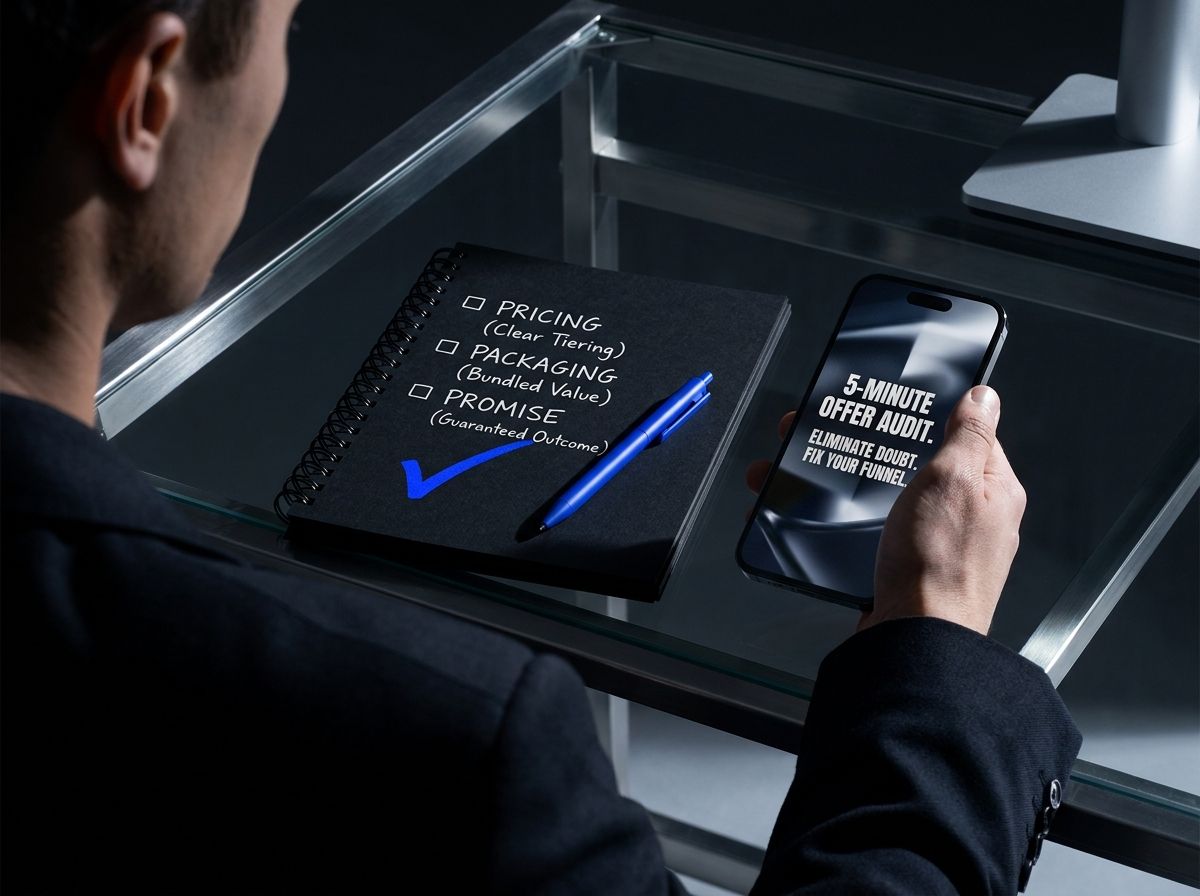
Minute 4: friction audit (where people drop before checkout)
You can have great pricing and packaging and still lose sales. Friction is the silent killer.
In this minute, you check the pre-checkout moments that decide whether someone stays.
Scan your page like a buyer with one question: "Is this for me, and will I regret it?"
Look for these friction points:
- A headline that describes the product, not the outcome
- Too much scrolling before the buyer sees the price
- A long video without a quick "who it is for" section
- A checkout that asks for too much personal info
- A lack of proof right where doubt appears
Then fix one thing you can change today. Just one.
Here are three quick fixes that often move the needle.
Fix 1: Put the "who it is for" line directly under the title
If your offer is for solo founders, say so. Do not hide it in the middle of the page.
Example line:
- "For solo founders launching a niche digital product who need a clear offer and a simple launch test."
Fix 2: Add a "what you get" block with counts
Counts are concrete. People trust concrete.
- "You get 12 templates, 6 walkthrough videos, and a 7-day implementation checklist."
Fix 3: Put proof next to the promise
Proof should not live at the bottom like a nice-to-have. It should support the exact claim.
Use one of these proof types:
- A short testimonial with context (what they did before, what changed after)
- A screenshot of results (with privacy respected)
- A "who this helped" statement (role, niche, constraint)
Also check your refunds and access terms. Clear terms reduce perceived risk.
If you want a simple friction test, do this: send the page to a friend who matches your buyer profile and ask, "What do you think you're buying, and what happens after purchase?" If they guess wrong, you have a packaging or promise mismatch.
This is the part where I admit something. I have audited my own offers and still missed the obvious. The timer helps more than you'd think. You stop overthinking and start seeing. Set it and go.
Minute 5: run the one-pass fix and publish it in one place
The audit is useless if you do not apply it.
So in the final minute, you build a one-pass update plan.
Pick one offer page and make changes in this order:
- Update pricing clarity (what it buys, access terms)
- Update packaging boundaries (what is included, what is not)
- Update promise specificity (who it is for, what changes, timeframe)
- Add friction fixes (who it is for line, what you get counts, proof near claim)
Then publish it in one place first.
If you sell through a landing page, update the landing page. If you sell via a checkout link, update the checkout page. If you run email funnels, update the email that drives to the page.
Do not spread changes across five channels at once. You want to know what moved.
Here is a simple "publish it once" checklist:
- The headline matches the outcome
- The first visible section includes who it is for and the promise
- The pricing card includes what the buyer gets and access terms
- The packaging section includes counts and boundaries
- Proof sits next to the promise
Now run a tiny test.
If you already have traffic, watch conversion rate for 48 to 72 hours. If you do not have traffic, run a small message test in your normal channel.
Your goal is not "viral." Your goal is signal.
Zentoko's adaptive learning system helps you keep your offer updates consistent across channels. It also gives you a way to reuse the same promise language and deliverable structure without rewriting from scratch each time.
And yes, you still need to decide your positioning. The audit forces that decision.
FAQ
How do I do an offer audit if I do not have sales yet?
You still audit. Your job is to remove ambiguity. Run the 5-minute checklist on your landing page and checkout, then ask three people in your target group what they think they are buying and when they would use it. If their answers are vague or wrong, your pricing, packaging, or promise is unclear.
What should I change first: pricing, packaging, or positioning?
Start with pricing clarity and packaging boundaries, then fix the promise. When buyers cannot tell what the price buys, positioning has no chance. When packaging is messy, promise claims sound hollow. After those are clean, positioning becomes easier to write.
Can I use this audit for services and coaching, not just digital products?
Yes. For services, the pricing clarity audit becomes "what is included, what is the time boundary, and what help exists." For coaching, packaging boundaries include session count, turnaround time, and what feedback looks like. The promise audit still needs specificity: who it is for and what changes.
How many pricing tiers should I have?
Start with one or two. One option works when your buyer has a clear need and trusts your promise. Two options work when you can clearly define a baseline and an upgrade with different outcomes or levels of support. Three-plus options are fine later, when you have data and segmentation.
What if my offer is good but conversion is still low?
Then you likely have a traffic-message mismatch or a friction issue. Run the friction audit minute and check whether the headline, promise, and proof match what your visitors saw in the first click. Also check checkout terms and load time. If those are clean, test one new promise angle that matches a real buyer constraint.
Your next step: run the audit today, then publish one clean version
Open your offer page. Set a timer for 5 minutes. Answer the five questions and apply the fixes in order: pricing clarity, packaging boundaries, promise specificity, then friction.
When you are done, publish one updated version in one place and track the next 48 to 72 hours. That is how you turn an offer audit into revenue instead of another document you never finish.
Join the conversation
Subscribe to comment
Join the Ziggyloo family newsletter to leave a comment — and get gentle learning tips and community stories in your inbox. No spam, unsubscribe anytime.