
The 30-Minute Offer Reframe: Fix Your Promise Without Rebuilding Your Brand
Your promise is fuzzy, your positioning feels off, and pricing psychology is fighting you. Reframe it in 30 minutes without rebuilding your brand.

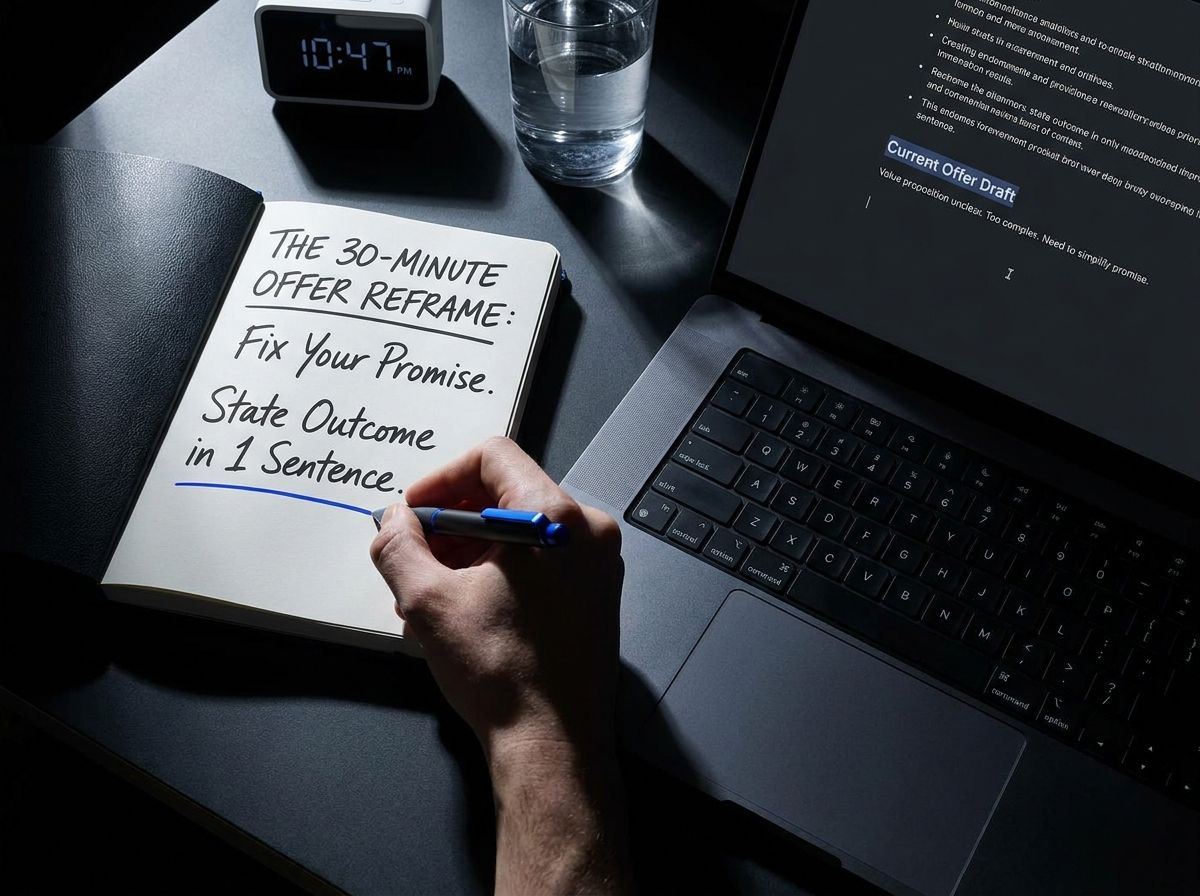
You open your laptop at 11:47 pm. You reread your homepage promise for the tenth time. It still sounds like everything you do, not the outcome your buyer actually wants.
That moment is the whole problem. Your promise is doing the work your positioning should do. The 30-minute offer reframe fixes that by rewriting the promise so it matches a specific job-to-be-done, with proof and a clear next step.
With Zentoko's adaptive learning system, you can turn the reframe into a repeatable brand launch move. You test messages without nuking your brand.
The 30-minute offer reframe in one sentence
An offer reframe is rewriting your promise so it becomes a clear, testable statement about what changes for a specific buyer, in a specific situation, and what they get to do next.
You are not changing your product. You are changing how people interpret it.
Here is the thesis: most "bad offers" are promise problems. The product might be solid. The positioning might be directionally right. But the promise is vague, broad, or emotionally true in a way that doesn't translate into a decision.
A promise that is too wide creates pricing resistance. People can't map it to their situation, so they treat the price like a gamble.
This is why the reframe works for solo founder brand launch. You do not have time to rebuild your site, redo your logo, and rewrite your entire content engine. You need a fast fix that makes your offer legible.
And yes, you are going to feel a little embarrassed that it took you so long to notice. That is normal. You are busy building, your buyer is busy deciding.
What you are changing (and what you are not)
You are changing:
- the promise language
- the buyer context
- the "what happens next" clarity
- the proof cues you attach
You are not changing:
- your core deliverable
- your niche selection from scratch
- your brand visuals
- your long-form content backlog
Why promises break during brand launch
You can have a good product and still lose the sale. The sale is a translation problem.
When your promise is unclear, buyers do three things: they do not feel seen, they do not understand the path, and they do not trust the price. That shows up as "I like it, but…" replies, ghosting after you send a link, and leads that ask for a discount before they ask for details.
Promise clarity is also where pricing psychology kicks in. People anchor on what they think they're buying. If your positioning says "help for busy parents" but your buyer is trying to "reduce bedtime fights this week," you are asking them to mentally do extra work. Mental work is cost.
Behavioral research on decision-making keeps pointing to the same theme: when people have to fill in too many blanks, they hesitate. Not because they're irrational, but because they're trying to avoid regret.
You can see this in your own behavior. When you shop for something online, you skim for a specific outcome. You want a sentence that makes you think, "Yes, that is the thing I want." If it takes more than a second to understand what changes, people bounce.
The most common promise failure modes
Here are the ones you can spot in your own copy fast:
- Your promise is a description, not an outcome. "I teach marketing for startups" is a topic. "You launch your first offer page that converts" is an outcome.
- Your promise is emotionally true but operationally vague. "Feel confident about your brand" sounds nice. It does not tell someone what to do or what will be different.
- Your promise tries to fit everyone. Broad promises feel safe to you. They feel risky to buyers.
- Your promise has no time horizon. Buyers want to know when the change happens, even if it is "in 14 days" or "in your next launch cycle."
A quick diagnostic you can do in 5 minutes
Open your offer page. Highlight the sentence that claims the value.
Then ask:
- Who is it for?
- In what situation?
- What changes?
- What do they get to do next?
- What proof cue supports it?
If you cannot answer those in one breath, you have a reframe job.
The 30-minute offer reframe workflow
Set a timer. Do not overthink. You are not writing a novel, you are fixing a promise.
This workflow is built for solo founder constraints: you need a repeatable move that works across niches and channels.
Minute 0-10: pick one buyer situation
Most promises fail because they talk about the buyer identity, not the buyer situation.
A buyer situation is a moment. It includes context and friction.
Instead of "for freelancers," use "when you have leads but no sales calls are booking."
Instead of "for parents," use "when bedtime is a battle and you need a routine that actually sticks."
Use a real moment you have heard from customers, DMs, or comments.
Concrete scenario A: You are a solo founder building a brand launch for a niche newsletter. You wrote "Grow your audience with better content." The situation is "You publish consistently but engagement stays flat for 30 days." Your reframe should target that.
Concrete scenario B: You are selling a workshop. Your promise is "Learn to price your offer." The situation is "You keep underpricing because you feel guilty charging." Your reframe should target the pricing decision moment.
Concrete scenario C: You are launching a productized service. Your promise is "Improve your landing page." The situation is "You get traffic but no one buys, and you do not know why." Your reframe should target the conversion gap.
Minute 10-20: rewrite the promise as an outcome statement
Now you write a single sentence that follows this shape:
Buyer situation + outcome + time horizon (optional but powerful) + what they do next.
Examples of promise reframe templates:
- "When X happens, you get Y in Z days, so you can do W."
- "You replace X with Y so your next launch step is clear and low-risk."
- "You turn A into B so pricing stops feeling like a guess."
Notice what changed. You moved from "what you do" to "what changes."
Also notice the positioning effect. Your promise becomes a positioning anchor. It tells the buyer what category you belong in and why you are different.
Minute 20-30: attach proof cues and a single next step
A promise without proof feels like marketing. Proof does not need to be a case study library. It needs to be believable.
Pick one or two proof cues you already have:
- a result you got (even small)
- a specific process artifact (a template, checklist, worksheet)
- a clear "what's included" breakdown
- a customer quote, even if it is short
Then add one next step sentence. Not a CTA button. A decision step.
Examples:
- "Reply with your niche and I'll send the exact promise rewrite for your offer page."
- "Choose a slot and you'll get a 30-minute promise audit before you commit."
- "Start with the first module and you'll have a message you can post the same day."
That next step is where pricing psychology stabilizes. Buyers like offers that reduce uncertainty.
Three promise rewrites you can steal today
You need examples that look like real copy, not theory.
Below are three rewrites across different brand launch shapes. Use them as a pattern, not a script.
Example 1: solo founder coaching offer
Original promise:
"Coaching to help you build a strong brand."
Reframe promise:
"When you are launching with no audience yet, you turn your ideas into a clear promise and positioning that makes your first offer page understandable, so people know what to do next."
What changed:
- "no audience yet" is the situation
- "clear promise and positioning" is the outcome
- "so people know what to do next" is the next step implied
Example 2: productized service with pricing resistance
Original promise:
"I help you set better pricing."
Reframe promise:
"When you keep discounting because your price feels risky, you use pricing psychology to anchor value and set a number you can defend, so you stop losing deals before the call."
What changed:
- situation is "discounting because risky"
- outcome is "anchor value and set a number you can defend"
- implied proof cue is the mechanism (pricing psychology), but you still need proof on the page
Example 3: newsletter or content brand launch
Original promise:
"Grow your newsletter with content strategy."
Reframe promise:
"When your newsletter gets views but no subscribers, you rewrite your message and your first three posts into a promise that matches the reader's problem, so signups stop feeling random."
What changed:
- "views but no subscribers" is the situation
- outcome is "rewrite message and first three posts"
- next step is "signups stop feeling random" (decision clarity)
A note about "promise" vs "positioning"
You might think promise and positioning are the same. They overlap, but they are not identical.
- Promise is the outcome statement your buyer repeats in their head.
- Positioning is the category and contrast that explains why you are the right choice.
A reframe fixes the promise so it carries positioning. It stops your message from sounding like a generic help offer.
How to test your reframe without rebuilding anything
You have the new promise sentence. Good. Now you test it in a way that tells you whether it fixes the sale.
You do not need a full brand launch overhaul. You need message tests.
Here is a simple testing plan that fits solo founder schedules.
Test where buyers already hesitate
Pick one place where your offer already gets attention:
- your landing page hero
- your email subject line
- your offer post caption
- your pinned post
- your first paragraph in a sales email
Change only the promise line. Keep the rest stable.
If you change everything, you will not know what worked.
Use three measurable signals
You are looking for evidence that the promise is legible and believable.
Track:
- click-through rate to the offer page (if you have a link)
- reply rate to your message (if you do DMs or email)
- conversion rate (if you have a checkout)
If you are early and have no conversion history, use "qualified replies." Someone asking the right question is a win.
A small testing script you can run in 48 hours
Send the reframe to your audience in two formats.
- Version A: promise in plain language.
- Version B: promise with a time horizon or a sharper situation.
Then compare replies.
Concrete scenario: you are launching a "promise audit" service.
You post on a weekday morning with the old promise and get 12 likes and no comments. Later that day you post again with the reframe promise and get 3 comments asking for the exact audit. Same audience size. Same topic. Different promise legibility.
That is your proof cue.
What to do if the reframe does not lift conversions
Do not panic. Most reframe failures are one of three things:
- The situation is wrong. You are targeting the wrong moment.
- The outcome is too broad. "Build a strong brand" still means nothing specific.
- The proof cue is missing. Buyers do not believe the promise yet.
Return to your diagnostic questions and tighten one variable at a time.
Pricing psychology: make the promise do the anchoring
Pricing psychology is not about tricking anyone. It is about reducing uncertainty.
When your promise is clear, buyers can mentally compare your offer to alternatives. When your promise is vague, they treat your price as a bet. They either negotiate or they leave.
So your reframe should help with three pricing moments:
- The "value anchor" moment: what are they buying?
- The "risk" moment: what could go wrong?
- The "fit" moment: why you, not someone else?
Use the promise to answer the value anchor question
A value anchor is a concrete outcome.
Instead of "help with marketing," use "a landing page promise rewrite that increases signup clarity."
Instead of "coaching," use "a 30-minute promise audit that gives you a sentence you can paste into your homepage."
Use the promise to reduce perceived risk
Risk drops when buyers see the path.
Add language that suggests a controlled process:
- "so you know what to do next"
- "so your next launch step is clear"
- "so you stop guessing"
You are not promising magic. You are promising direction.
Use the promise to improve fit
Fit improves when you name the situation.
Your buyer thinks: "Oh, they get my exact problem." That is positioning through specificity.
A practical checklist you can paste into your notes
Before you publish the reframe, check:
- Is the promise one sentence?
- Does it name a buyer situation?
- Does it name an outcome?
- Does it imply a next step?
- Do you have one proof cue nearby?
If you can't answer those, your promise is still sitting in "marketing fog."
Common mistakes that waste your 30 minutes
You might be tempted to spend the whole timer editing your entire brand story. Don't.
The reframe is narrow on purpose.
Mistake 1: rewriting the promise but keeping the same buyer context
If your buyer situation stays "busy founders" or "parents who want better," your promise will still feel generic.
You need a moment. A friction point. A trigger.
Mistake 2: making the outcome sound impressive but not usable
"Elevate your brand presence" is not an outcome. It is a vibe.
Your buyer needs to know what changes in their actual work. Specifically. This week.
Mistake 3: removing proof to sound more confident
Confidence without proof reads as hype.
Keep one proof cue on the page, even if it is small. A template is proof. A specific deliverable is proof. A result you got is proof.
Mistake 4: changing positioning in a way that breaks your existing audience
If people already know you for a certain niche angle, your reframe should intensify that angle, not replace it.
A good reframe tightens. A bad reframe whiplashes.
Mistake 5: testing too many changes at once
If you update the hero, the pricing, the CTA, and the whole page design, your results are noise.
Change one thing. Learn. Then change the next thing.
Your next step: do the reframe on your offer right now
Pick the offer you want to sell next week. Open the page or draft where your promise lives.
Set a timer for 30 minutes.
Write one new promise sentence using this order:
- Buyer situation
- Outcome
- Time horizon (optional)
- What they do next
Then add one proof cue next to it.
Finally, test it in one place within 48 hours.
If you want a shortcut, paste your current promise into the "when X happens, you get Y so you can do Z" shape. That single move is usually enough to fix the offer reframe. Most people would've saved weeks of confusion by doing just this one thing earlier.
And if it still feels off, you do not need a new brand. You need a sharper situation and a more usable outcome.
FAQ
What is an offer reframe, and how is it different from a brand refresh?
An offer reframe is a rewrite of your promise and positioning cues so buyers understand the outcome and next step. A brand refresh changes visuals and story. Reframes are faster and they fix the decision problem first.
How do I write a promise that works for my solo founder brand launch?
Start with a real buyer situation you have seen in DMs, comments, or sales calls. Then write the outcome your buyer gets and what they can do next. Keep it to one sentence and add one proof cue nearby.
Does promise clarity affect pricing psychology?
Yes. Clear promises reduce uncertainty, so buyers can anchor value without mental guesswork. When the promise is vague, buyers treat the price like a gamble and either negotiate or leave.
What if my offer is good but conversions are still low?
That often means the promise is not legible. Run the 5-minute diagnostic: identify whether your promise is an outcome or a description, whether the buyer situation is specific, and whether you have proof cues. Then reframe only the promise line and test.
How long should the reframe take me?
Thirty minutes is enough for a first pass. If you do it in under 30, you probably skipped the buyer situation. If you spend hours, you are probably editing your whole brand instead of fixing the promise.
Join the conversation
Subscribe to comment
Join the Ziggyloo family newsletter to leave a comment — and get gentle learning tips and community stories in your inbox. No spam, unsubscribe anytime.