
From Idea to Offer in 48 Hours: A fast pricing + packaging workshop for solo founders
You do not need a perfect business plan. You need a priced offer you can sell this week. Here is a 48-hour workshop you can run on your own.

Elena is standing in her kitchen in socks she refuses to throw away. Her laptop is open to a messy doc titled "digital product thing." Her tea is going cold while she argues with herself about whether $19 is too cheap or $49 is too bold.
Then her phone buzzes. A friend asks, "So what is it, exactly? And how much?" Elena stares at the question like it's a trap. It is not. It is the moment you realize your idea is not an offer yet.
That is what this 48-hour pricing + packaging workshop fixes. You will turn a half-formed idea into a clear offer, with a price you can defend and a product format you can actually deliver.
With Zentoko's adaptive learning system, you can build the offer and packaging decisions around what people actually do, not what you hope they want.
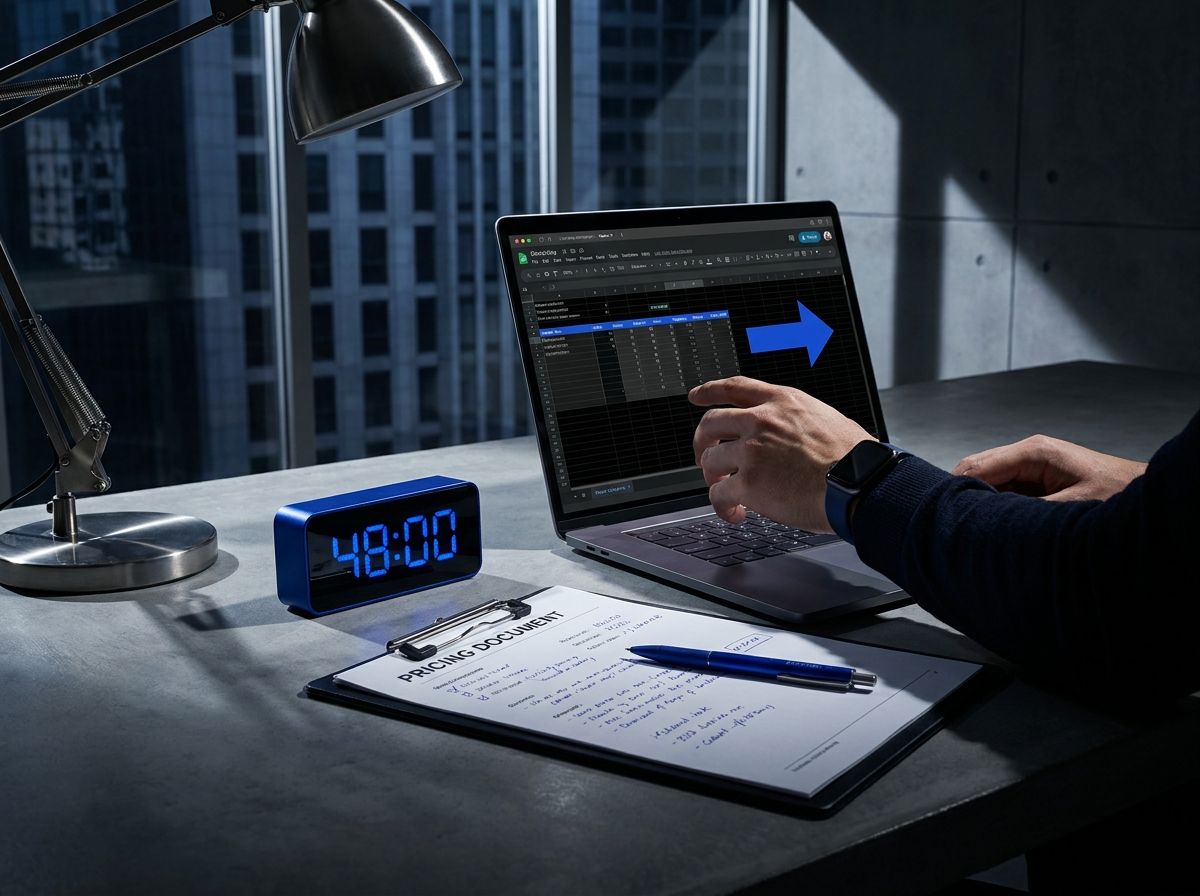
What you are really doing in a 48-hour pricing workshop
A pricing workshop is not "pick a number." It is "decide the shape of the value."
When you price a digital product, you are pricing outcomes, time saved, and risk removed. When you package it, you are telling people how the work will feel and how long it will take.
If you have ever stared at your own offer page and thought, "I would buy this if it were clearer," you already know the problem. Your audience is not missing your intelligence. They are missing your structure.
So your workshop has one job: turn your idea into a sellable promise.
Here is what you will end with after 48 hours:
- A one-sentence offer creation statement you can paste into DMs
- A product format that matches how people learn and act
- 2-3 price options with a simple reason for each
- A packaging outline you can build in a weekend
And yes, it will be a little imperfect. That is the point. You are not writing a thesis. You are creating something you can test.
The 48-hour agenda (designed for solo founder reality)
You are not a studio team. You are a person with a calendar, a brain that gets tired, and a to-do list that grows whenever you blink.
So this agenda runs like a sprint, not a retreat.
Hours 0-6: harvest signals and stop guessing
Start by writing down what you already know. Not "what you want to believe." What you have actual evidence for.
Open a doc and create three sections:
- Who is this for (be specific)
- What problem are they trying to solve (in their words)
- What would success look like in 7 days (not 7 months)
If you have no audience yet, you can still do this. Pull from comments you have gotten on related posts, questions people ask when they are not ready to buy, or your own experience living inside the problem you are solving.
Then do one quick exercise. Write 10 "if they could, they would..." sentences. For example: "If they could, they would stop rewriting the same landing page."
This is how you locate real pain. Not the pain you imagine. The pain that makes someone type a question into a search bar at 11 PM.
Practical takeaway: when you are stuck on pricing, it is usually because you have not decided what the buyer is trying to accomplish this week.Hours 6-14: build your offer creation statement
Now you turn those harvested signals into an offer.
Use this template:
Your offer helps [who] achieve [specific outcome] in [timeframe] without [main frustration].
Do not overthink the words. The goal is clarity, not poetry.
Then write three versions:
- Version A is for the reader who wants results fast
- Version B is for the reader who wants less stress
- Version C is for the reader who wants confidence
Pick the version that feels easiest to explain out loud. Out loud matters, because if you stumble over it in conversation, your sales page will stumble too.
Practical takeaway: your offer creation statement becomes the anchor for your pricing workshop. If you cannot say it cleanly, you cannot price it cleanly.
Hours 14-26: product packaging that matches how people act
Packaging is how your product behaves in the real world.
A lot of founders package like they are building a library. They create modules, lessons, and PDFs, then wonder why nobody finishes. People do not buy "content." They buy a path.
So decide what your product actually does for the buyer.
Pick one primary format and one supporting format:
- Primary: guided course, workshop replay, templates + walkthrough, or coaching-style prompts
- Supporting: email sequence, office hours recordings, community prompts, or a swipe file
Then define the "day in the life" experience by answering these questions in plain language: What does the buyer do on day 1? What does the buyer produce by day 2? What does the buyer have by day 7?
If you cannot answer day 7, your packaging is too vague. Full stop.
Practical takeaway: digital product pricing is easier when you can describe a tangible output the buyer will hold in their hands quickly.Hours 26-36: digital product pricing using 3 price anchors
Now the part everyone fears. Pricing.
You do not need a spreadsheet with 37 tabs. You need anchors that stop you from swinging wildly.
Use three price points:
1) Low anchor (entry): the price a buyer can say yes to without thinking too hard
2) Core anchor (most likely): the price that covers your work and feels fair for the outcome
3) Premium anchor (opt-in): the price for someone who wants faster results or more support
You are going to choose these anchors based on two things: how quickly your buyer can reach success (your timeframe) and how much effort they must put in inside the product (your packaging).
Here is a simple rule that keeps you honest:
- If the buyer needs a lot of effort and still faces uncertainty, price lower.
- If the buyer gets a clear path, templates, and a guided process, price higher.
If you are stuck, start with the core anchor and ask: would I buy this if I had to do the work today?
Then write the "defense line" for your core price. Your defense line is one sentence you can use when someone asks why it costs what it costs.
Example defense line: "It costs $X because in 7 days you walk away with [specific output] and a ready-to-use system to keep going."
Practical takeaway: you are not just selling a product. You are selling reduced risk and reduced confusion.Hours 36-44: build your offer page structure (so it sells itself)
Pricing without packaging is confusing. Packaging without a page is invisible.
You need a simple page structure. Not fancy. Not long.
Use this skeleton:
- Headline that repeats the offer creation statement
- "Who it is for" bullets (3-5)
- The outcome in 7 days (1 section)
- What is included (clear list)
- How it works (3 steps, short)
- Pricing and what changes at each tier
- FAQ that answers objections
Keep the language specific. Replace "improve your brand" with "publish a landing page that converts without rewriting it 10 times."
Practical takeaway: your page is not a brochure. It is a decision helper.Hours 44-48: write your launch message and test it immediately
You now have an offer. Your next move is to find out whether people actually understand it.
Send 3 messages to 3 different people: one to someone who asked you a question recently, one to a peer in the same niche, and one to someone adjacent who might care.
Use the same offer creation statement in each. Add the core price and the 7-day outcome.
Example message:
"Hey [name]. I built [offer] for [who]. In 7 days you will [outcome]. It is $[price] and includes [1-2 inclusions]. Want the link?"
If you get replies, you refine. If you get silence, fix clarity first, price second.
Practical takeaway: you learn faster from understanding than from persuasion.The workshop outputs you should not skip
At the end of 48 hours, you should have these artifacts ready to reuse.
1) A one-sentence offer creation statement
This is the sentence you will use everywhere. DMs, landing page headline, email subject lines, the first line of your sales page.
If you cannot fit your offer into one sentence, you have not decided what the product is yet.
2) A packaging outline that produces a day-7 outcome
Packaging is not a list of materials. It is a sequence of actions.
Make sure you can tell someone what they will do on day 1 and what they will have by day 7.
3) 3 price anchors with defense lines
Your defense lines are how you stay calm when someone asks "why."
You are not arguing. You are clarifying.
4) A simple tier structure
You need at least a core tier. A premium tier is optional, but it is useful if you can add support or speed.
If you do not have support to offer, do not fake it. Add a faster review cycle, extra templates, or office hours recordings only if you can actually deliver them.
Practical takeaway: the goal is not "perfect pricing." The goal is "a pricing decision you can explain."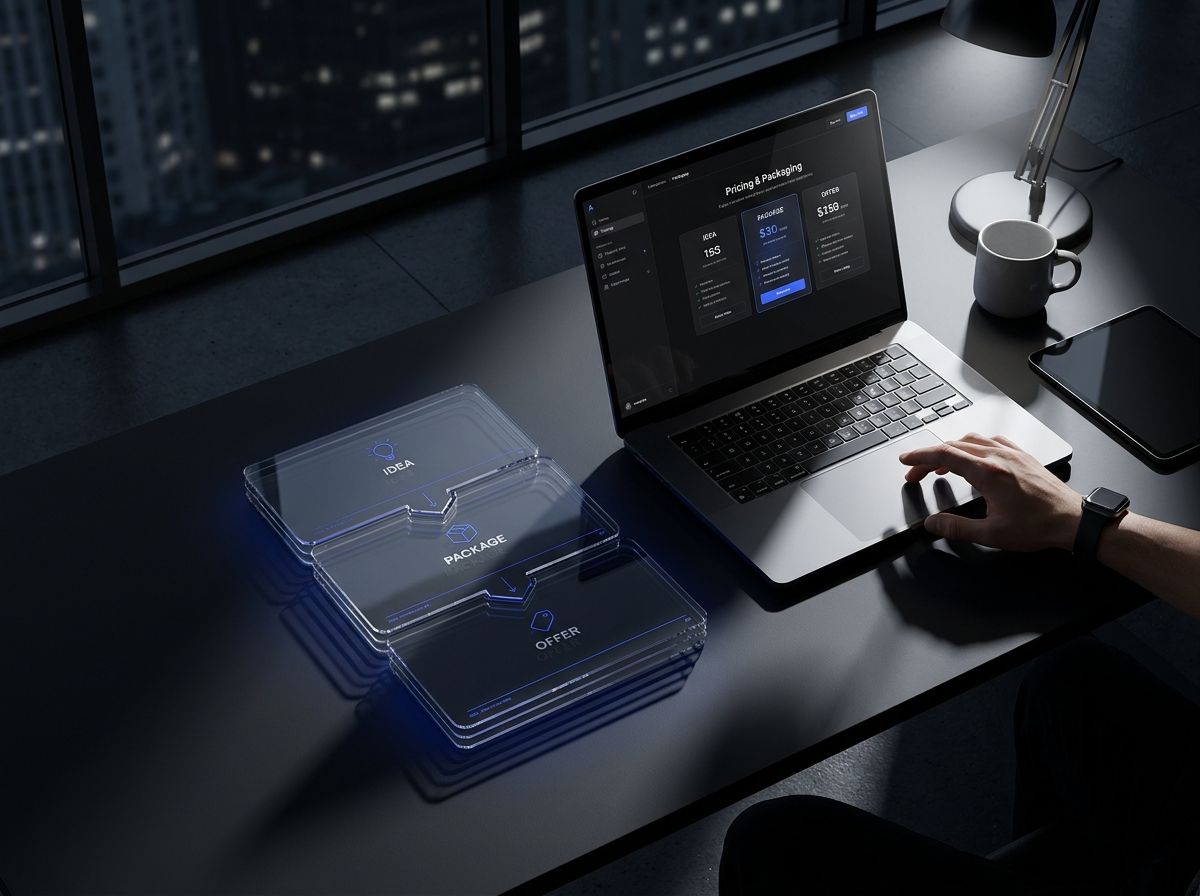
Common failure points (and what to do instead)
Let me guess what happened the last time you tried to price and package something.
You started building content. Then you got stuck. Then you priced too low because you were nervous, then too high because you were tired, then you told yourself you would fix it later.
You are not lazy. You are under-structured.
Here are the usual failure points and the fixes.
Failure point: you price before you define the outcome
Fix: write the day-7 outcome before you touch pricing.
If you cannot describe the outcome in plain language, your price is guesswork.
Failure point: your packaging is a pile of lessons
Fix: convert lessons into actions.
For each module, ask: what does the buyer build or decide by the end of this section?
Failure point: you overfit to what you would buy
Fix: anchor to what people actually ask for.
If people ask about "clarity," your product should produce clarity fast. If they ask about "templates," your packaging should include templates that get used, not just downloaded.
Failure point: you hide behind "custom"
Fix: make a clear starting point.
Even if you eventually do custom work, your first offer should be standardized. Standardized products are testable. Custom work is not.
Practical takeaway: your workshop is a constraint. Constraints create decisions.How to run this workshop with a real community vibe
This post is labeled community for a reason. You do not need to do this alone in silence.
If you have even one friend building in the same space, invite them to be your "question gremlin."
Here is the role: they ask you "who is this for?" and you answer without explaining your whole life story. They ask "what do I do in week one?" and you point to your packaging sequence. They ask "why does it cost that?" and you use your defense line.
You are not looking for agreement. You are looking for confusion, because confusion is data.
If you are running solo, you can still simulate this. Pick one person you trust. Send them your one-sentence offer creation statement and ask:
"What do you think this is? What do you think you get? What do you think you have to do?"
Their answers will show you exactly what your packaging and pricing are communicating, versus what you think they are communicating.
Practical takeaway: clarity is a team sport, even if you are the only player.FAQ
Why does my child not care about the price I set?
If you are talking about a child, they are not the buyer. They are the observer, and they react to mood and tone, not pricing logic. What matters is whether the adults around them understand what the product is and why it helps.
If you are talking about your audience, the real issue is usually clarity. Rewrite your offer creation statement so it names the outcome and the day-7 deliverable.
How do I choose a price when I have zero sales?
Start with your day-7 outcome and your packaging effort. If your buyer gets a clear path and a tangible deliverable quickly, your core anchor can be higher. If it requires a lot of effort and they still feel uncertain, anchor lower.
Also, use 3 anchors instead of one number. It gives you room to test without panic.
What if my product packaging is "just templates"?
Templates can sell extremely well when they come with a walkthrough and a sequence. Packaging is how the buyer uses the templates, not how many files you drop into a drive.
Add prompts, examples, and a day-1 to day-7 workflow. Then price based on the outcome and reduced risk.
Should I launch at the lowest price to get traction?
You can, but do it intentionally. If you underprice, you may attract the wrong buyers and you may teach the market that your work is cheap.
Use the core anchor for your main offer creation statement and test understanding first. Adjust price if the offer is clear and you still do not get interest.
Your next step (do this today)
Open a doc and write your offer creation statement using the template: who, outcome, timeframe, without frustration.
Then write the day-7 outcome in one sentence. Not a dream. A deliverable.
Once you can describe that, pricing becomes a decision you can defend, and product packaging becomes a path you can build.
You are closer than you think. Your idea just needs structure, and you can create that structure in 48 hours.
Join the conversation
Subscribe to comment
Join the Ziggyloo family newsletter to leave a comment — and get gentle learning tips and community stories in your inbox. No spam, unsubscribe anytime.