
From attention to action: how to build a simple conversion path (no funnel overwhelm)
You do not need a fancy funnel. You need one conversion path that turns attention into leads and leads into a sale.

Elena is standing at her kitchen counter with cold coffee and a half-finished to-do list. She posts a helpful thread, gets a burst of likes, and then nothing. No replies. No new emails. Just the same quiet inbox she started with.
Then her friend Marcus texts: "Did you have a place to send them?"
You know what that feels like. You monetize attention by building a conversion path that takes someone from "Oh, that's for me" to "I bought it." Not someday. Not after you build a whole funnel. Today.
The real problem is not traffic. It is the gap
Most people think the bottleneck is reach. So they crank out more posts, try another platform, and hope the algorithm gets bored and gives them something back.
But the gap is usually simpler. Attention lands in your world, then it falls through a hole.
That hole looks like one (or more) of these:
- You post, but you do not have a single landing page that matches the post.
- You have a landing page, but it is vague. The message does not lead to a clear call to action.
- You have a call to action, but it is too big. You ask for a sale before you earn the decision.
- You ask for emails, but you do nothing with them. So your lead to sale never happens.
A conversion path is just the sequence that closes the gap. Not a "funnel." Not a complicated system with ten steps and a dozen tools. It is the path from attention to action with one job per step.
With Zentoko's adaptive learning system, you can turn attention into action without building a messy maze. You still decide what the next step is. You just do it with less guesswork.
What a simple conversion path actually includes
A conversion path has three parts you can build in an afternoon: a message that matches what people saw, a landing page that answers the "so what?" question, and a single call to action that leads to the next step. That is it. Not a "strategy deck." Not a 40-page funnel map. Just a clean route.

Build your conversion path around one question
When you stare at your own marketing, everything starts to blur. You can feel the effort. You can see the work. You just cannot see the decision your reader is making.
So use one question as your compass: "What do they do next, right after they realize this is for them?"
If you cannot answer that in one sentence, your conversion path is too crowded.
Step 1: Match the message to the moment
Your post, video, email, or comment is a moment. People click because something in that moment makes them think, "This solves my problem." Your landing page has to keep that promise.
Here is a practical way to do it without overthinking:
- Write your landing page headline as a restatement of the post's promise.
- Use the same wording people used to describe their problem.
- Put the call to action above the fold.
You are not trying to impress anyone. You are trying to reduce confusion.
Elena did this the next day. Her thread was about "helping kids focus during homework." Her old page talked about "parent coaching in general." Her new page said: "Get a focused-work routine you can use tonight." Same topic. Same moment. (It took her about 20 minutes to rewrite it, which is honestly the whole point.)
Step 2: Make the landing page do one job
A landing page is not your homepage. It is not your brand story museum. It is the place where attention becomes a lead or a sale.
Your landing page job is to answer the questions people ask in their head while they decide:
- Is this for someone like me?
- What do I get?
- How fast will I see something?
- What happens after I click?
You do not need to answer every possible question. You need to answer the ones that block action.
A simple landing page layout that works for digital brands:
- Headline and promise
- 3-5 bullets that describe outcomes (not features)
- The offer details (what it is, who it is for)
- Proof (even small proof)
- The call to action button
If you have no proof yet, you can still be specific. "I built this for X, and it helps Y do Z" counts as proof of intention. Beta results are even better.
But do not hide behind "coming soon." People are not buying your potential. They are buying what you can do right now.
Step 3: Choose one call to action that leads to the next step
A call to action is not a button label. It is a promise about what happens after the click.
Your call to action should match the level of commitment people can make right now.
For most digital brands, you need two possible paths:
- Lead path: "Get the guide" or "Join the waitlist" or "Book a quick call."
- Sale path: "Buy now" or "Start now."
If you try to go straight to "Buy now" from every post, you will feel like you are shouting into a parking lot.
If you only collect leads and never move them toward a decision, your lead to sale stalls.
So pick one path for each piece of attention.
Here is a rule you can actually use:
- If the audience is cold, use a lead path.
- If the audience is warm, use a sale path.
Warm means they already engaged. They clicked. They replied. They asked a question. They watched long enough to show real interest. Cold means they landed once and bounced.
The "no funnel overwhelm" version of the path
If you want the shortest conversion path you can build, use this:
- Post or video -> Landing page -> One call to action
That is the minimum viable conversion path.
You can still earn money with that.
You will just learn faster when you add one extra step for leads.
Add one step for leads. Keep the rest simple
You do not need a 12-email sequence. You do not need a complicated nurture track. You need a lead path that moves people toward a decision.
Think of it like this: your landing page is the door. Your follow-up is the hallway.
If the door is clear and the hallway is short, people walk.
When your call to action is "get the guide," you still need a lead to sale path
Let's say you offer a checklist, a mini course, or a template. People opt in. Great.
Now what?
If you never connect the guide to the paid offer, your lead becomes a dead end. Full stop.
You need one conversion bridge. That bridge can be:
- A "next step" email
- A short onboarding sequence
- A call booking link
- A limited-time offer tied to what they just downloaded
Keep it small.
A simple lead to sale bridge looks like this:
1. Email 1: Thank them and explain what to do with the guide today.
2. Email 2: Show a quick example or mini-case of the guide working.
3. Email 3: Invite them to the paid offer with a clear reason.
Three emails. You can write them in one sitting.
Do not make it fancy. Make it useful.
What to write on the landing page when you want a sale
If your call to action leads to a purchase, your landing page needs to handle the last-mile objections.
People hesitate for predictable reasons:
- "Will it work for me?"
- "Is this worth the price?"
- "What if I do it and it does not click?"
You handle those with specificity.
Use these tactics:
- State the exact outcome you help them get.
- Explain the time commitment in plain language.
- Add a guarantee or risk reversal if you can.
- Include a short FAQ on the page.
And yes, include a call to action that is not buried.
A button that says "Get started" is fine. A button that says "Start your first session today" is better.
How to monetize attention without feeling like a salesperson
You are not trying to "sell." You are trying to help people take the next step.
That difference matters in how you write.
Instead of talking about your brand, talk about the reader's situation and what happens next.
Here are lines you can adapt:
- "If you want this to be easier this week, start here."
- "If you're stuck on X, this shows you Y."
- "If you want results in Z days, this is the path."
It is still marketing. It is also honest.
And if you feel awkward about it, you are normal. Most of us started writing because we cared about something. Then we tried to monetize attention and our brain panicked. You can care and still ask for action.
Build, test, and improve your conversion path in a way that feels survivable
You do not need a huge experiment plan. You need a loop you can run while you still have a life.
A conversion path should be testable.
If you cannot change one thing and see what happened, you are not testing. You are guessing.
Run the simplest A/B test you can
Pick one change at a time:
- Change the call to action text.
- Change the headline promise.
- Change where the button sits (top of page vs mid page).
- Change one section: outcomes bullets or proof block.
Then track one metric: landing page conversion rate (click to lead, or visit to purchase).
Do not obsess over likes, comments, or follower count. Those are attention signals. They are not the action you want.
Use a "traffic to action" checklist
Before you blame your offer, check your path:
- Does your landing page match the post topic in the first line?
- Is the call to action clear and visible?
- Is the offer described in outcomes, not just activities?
- Is the next step easy to complete on mobile?
- Do you have at least one piece of proof (even small)?
If you answer "no" to two or more, fix those first.
It is usually not your audience. It is the path.
Track what matters without turning your life into a dashboard
You only need three numbers for this loop:
- Clicks to landing page
- Conversion rate on the landing page
- Lead to sale rate (or purchase rate)
If clicks are low, your attention engine needs work. If clicks are fine but conversion is low, your landing page and call to action are the issue. If conversion is fine but sales are low, your follow-up or offer fit is the issue.
This is where people get stuck, they try to solve everything at once.
You do not need to. You need to fix the bottleneck.
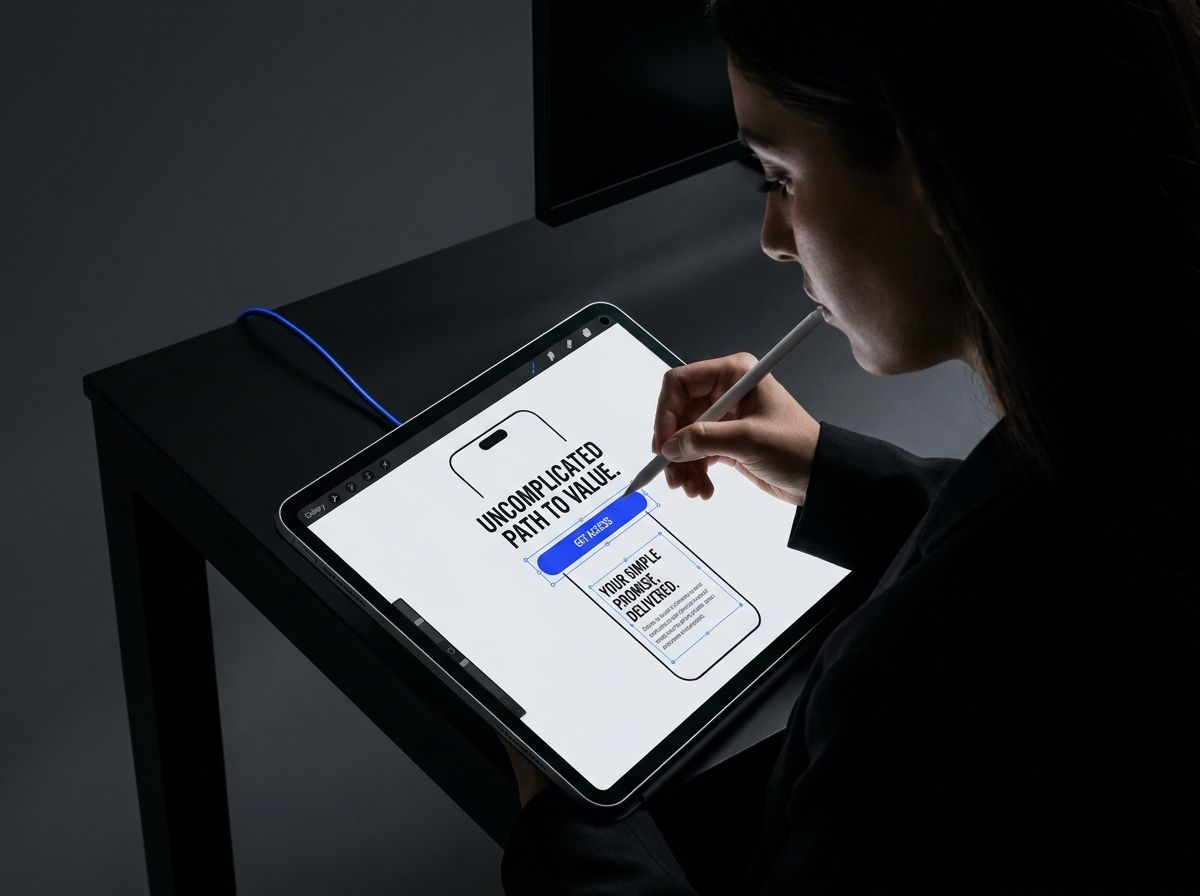
Common conversion path mistakes that feel like "funnel overwhelm"
You are not failing. You are just building the wrong thing.
Here are the mistakes that create that messy funnel feeling, even when you swear you are keeping it simple.
Mistake 1: One offer, ten messages
You post about your offer in ten different ways. Then your landing page tries to satisfy all ten audiences.
The result is a page that feels like it is talking to everyone and committing to nothing.
Pick one promise per landing page. One conversion path per offer.
Mistake 2: You collect leads but do not connect the dots
Your guide download is a nice moment. It is also a dead end if you never invite them to the next step.
Your lead to sale path can be short, but it must exist.
Mistake 3: Your call to action sounds like a vague suggestion
"Learn more." "Check it out." "Explore."
Those are not calls to action. Those are invitations to stay curious forever.
Make it specific:
- "Get the checklist"
- "Start the first session"
- "Join the next cohort"
Mistake 4: Your landing page is too long for the moment
Long pages can work, but only when the traffic is warm and the reader is ready to decide.
If you are sending cold attention, keep the landing page tight. Give them the promise, the outcomes, the proof, and the next step.
You can always expand later.
Mistake 5: You try to build your conversion path after you run out of energy
This one is personal because I have done it too.
You post because you have to. Then you think, "I will build the landing page later." Later becomes next week. Next week becomes next month. The post fades. Your conversion path never gets built.
So build it first, then post.
Or at least build it before you push the post hard.
Momentum is real. So is decay.
A simple example you can copy for your digital brand
Let's make this concrete. Imagine you run a digital brand that helps busy parents build a calmer bedtime routine.
You post a short video: "If bedtime is a fight, try this 2-minute reset before pajamas."
Your conversion path could be:
- Video -> Landing page
On the landing page:
- Headline: "Get the 2-minute bedtime reset routine"
- Bullets: what it does, who it is for, and what changes in the first week
- Proof: a short quote from a beta parent or a screenshot of results (with permission)
- Call to action: "Get the routine"
Then your lead bridge:
- Email 1: how to use it tonight
- Email 2: a short story of how it worked for someone else
- Email 3: invite them to your paid coaching or program with a clear reason
That is a conversion path. It turns attention into action without turning your life into funnel maintenance.
FAQ
Why does my content get attention but not sales?
If you see engagement but no purchases, the gap is usually your landing page and call to action, not your content. The reader might not know what to do next, or the offer might not match the promise you made in the post. Tighten the message match and make the next step obvious.
What should my landing page include if I have a small audience?
Keep it simple: headline promise, a few outcome bullets, offer details, one proof element, and a clear call to action. Small audiences can still convert if the landing page reduces confusion. You do not need to "scale" your page. You need to make it specific.
Should I send leads to a freebie or straight to the sale?
Cold attention usually converts better to a lead path first because the commitment is lower. Warm attention can go straight to a sale if your landing page handles objections clearly. If you are unsure, test one post with a guide download and another with a direct purchase.
How do I improve my conversion path without redesigning everything?
Change one piece at a time: the headline promise, the call to action text, the placement of the button, or one section like proof. Watch landing page conversion rate after each change. Small edits often beat big redesigns because they keep your message consistent.
Your next step
If you feel like you are doing "all the marketing" but nothing turns into revenue, you are not broken. You are just missing a clean conversion path.
Pick one offer. Pick one landing page. Pick one call to action that leads to the next step. Then post with that path already in place.
Do that for a week. You will learn faster than you would've with another round of "more content." And you will feel the difference in your inbox.
If you want a place to start, open your current landing page and rewrite the headline so it matches your last post in plain language. Then move your call to action higher. That is a real improvement you can make today.
Join the conversation
Subscribe to comment
Join the Ziggyloo family newsletter to leave a comment — and get gentle learning tips and community stories in your inbox. No spam, unsubscribe anytime.